Showing posts with label Illustrator: Grobler. Show all posts

Monday, November 15, 2021

Africa at the Internet Archive: Bojabi Tree

I've got a fun story to write about today that provides a wonderful example of how a public domain source can provide inspiration for book authors and illustrations: it's the African folktale of the Bojabi Tree!

Here's a public domain version by Edith Rickert: The Bojabi Tree: An African Folktale, published in 1923, and just a click away at the Internet Archive. 


The word Bojabi is still in play here, but the animals have been de-Africanized in this version of the story (perhaps not surprisingly; Rickert was a Chaucer scholar by profession, not an Africanist), but see below for two other versions with African animals.

The illustrations are by Gleb Botkin (a fascinating character in his own right; see Wikipedia), and since they are in the public domain, that means they can be repurposed. Some enterprising publisher could do a coloring-book version, for example, encouraging students to color the black-and-white drawings:


To get a sense of the influence and impact of this book, you can search "text contents" at Internet Archive for the title and author to see the huge number of books and magazines (over 150) that reference this book.

That was, in fact, how I discovered this more modern edition of the book by Dianne Hofmeyr, The Magic Bojabi Tree, also at Internet Archive. (For reasons not clear to me, this book also appears with the title The Name of the Tree is Bojabi.) Unlike Rickert's book, this book uses traditional African animals:


Even better: the illustrations are by one of my favorite children's book artists, Piet Grobler! 


You might remember Piet Grobler's work from two beautiful books by Beverley Naidoo that I had featured in this blog previously:  The Great Tug of War and Other Stories and Aesop's Fables (retold with Africa in mind).


While Rickert did not specifically mention the source she used for her book, I'm 99% certain her source (directly or indirectly) was this book by Robert Nassau, which is one of my favorite collections of African folktales and the subject of a previous blog post here: Where Animals Talk: West African Folklore Tales, published in 1912.


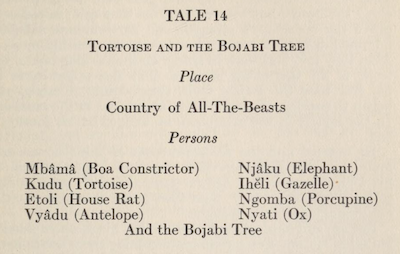
You will find Nassau's version of the story here on p. 129. You can see the cast of characters (he lists the characters like this for each story, which I really like): even the African porcupine had a role to play in this version of the story! Nassau gives the African names the animals, and in this case they are Benga names; Nassau heard this story from a Benga storyteller (more about the Benga people).

So, the Internet Archive abounds in Bojabi Trees... maybe you will be curious and want to read about one of them! Or more than one!

by Edith Rickert


by Dianne Hofmeyr


Thursday, September 2, 2021

African Folktales at Internet Archive: The Great Tug of War

With the theme this week being stories from southern Africa, that is a perfect excuse to share this book of folktales told by Beverley Naidoo: The Great Tug of War and Other Stories, and it's just a click away at Internet Archive.

There are wonderful animal stories in here: The Great Tug-of-War (which you see there on the cover), Little Animals Should Not Make Fun of Big Animals!, Who Shall Drink?, The Race, King Lion in Love, The Lion Who Danced With Dinner, The Hare and the Horns, and Does One Good Turn Deserve Another? You can find out more about Beverley Naidoo's life and work at Wikipedia and at her website: BeverleyNaidoo.com

The illustrations are by Piet Grobler, and he brings so much personality to all the animal characters (and you can find out more about Grobler's work at his website). Here is Tswhene the baboon carrying away Mmutla the rabbit (the animals have their Tswana names; see the list in the back of the book):

You'll also find this traditional African version of the "tar-baby" story, where it is Khudu the tortoise who smears himself with sticky stuff to trap the thieving rabbit:

I first became aware of Beverley Naidoo's work because of her edition of Aesop's fables, also illustrated by Piet Grobler, which takes an African-focused approach to the stories (an approach that I'm increasingly persuaded is what we need in order to understand the range of Aesopic stories); you can find her Aesop book at Internet Archive also: Aesop's Fables. 

Here is how Grobler depicted Aesop being captured and carried away to the north as a slave:

There are already some distinctively African animals in the Greco-Roman collection of Aesop's fables (which has always been part of the argument for an African component to the Aesop tradition in the ancient world), and Naidoo has recast the fables here with African characters, like this story about the goat and the fox in the well recast as a the story of a jackal and a klipspringer:

Whether you read Naidoo's retellings of traditional African folktales, or her African take on Aesop's fables, you get to enjoy Grobler's illustrations in both books. Both highly recommended!


by Beverley Naidoo