Showing posts with label Author: Bryan. Show all posts

Thursday, July 21, 2022

African Diaspora at Internet Archive: Turtle Knows Your Name

I've updated this post with additional information about Bryan's source material. :-)

For one last Caribbean story this week, I wanted to write about another book by the late, great Ashley Bryan; for this one, he based the story on a Caribbean folktale: Turtle Knows Your Name.


You will recognize Bryan's distinctive style right away of course: 


In the traditional folktale of this type, the "granny" is a more sinister figure, a dangerous witch whose name holds special powers. In some versions, the folktale serves as an origin story for how the turtle or crab, etc. got its shell: when the water-creature reveals the witch's name, she punishes it by throwing a calabash at it, and the calabash sticks and becomes the shell. Here's a version of the story in Philip Sherlock's Tales from the West Indies: "How Crab Got a Hard Back." This type of story is also found in Africa; here's a version from Burkina Faso, for example: "How the Crab Got Its Shell."

Bryan began from this story told by Henry Mars of in the harbor town Oranjestad in Saint Eustatius (to the southeast of the Virgin Islands), as collected by Elsie Clews Parsons: Turtle Tells Her Name. In this story, a wicked grandmother won't give her grandson any food unless he tells her her name. Finally one day the boy is able to tell her her name: Mapesiedo-makwindy-ai-ai-akwindy. The grandmother has to feed him but she is angry, so she wants to find out who told him her name. She asks the donkey, but the donkey just replies hee-haw; she asks the goat, and he just replies bah-bah, then the horse, and finally the turtle. The turtle admits that he told her name to the boy.

In Bryan's version, these events are part of the story, but their significance changes completely by the way he sets them up. The grandmother lovingly raises the boy, who has a very long name. The other children make fun of his long name, but the grandmother teaches him to be proud of his name. The boy hopes the animals might learn his name but none of the animals say his name back; they just make their usual animal sounds. But the turtle knows his name; the turtle heard the grandmother and the boy singing his name on the beach. One evening after dinner, the grandmother tells the boy he cannot have dessert unless he can tell her her name. He only knows to call her "granny," so he goes to find out her name from the animals. None of them can tell him, but then he asks the turtle, and the turtle tells him her name, but commands the boy not to say who told him. The grandmother happily gives the boy dessert and then goes to find out who told him her name. The animals just make their animal sounds, but then she asks the turtle, who explains that he hears all the names sung on the beach, and he remembers when she was a little girl and got her name. The grandmother goes home and makes the boy promise not to tell anyone her name; he will call her "granny" like before, and now she will call him "son."


So, the grandmother in this story is entirely nice, and the threat made with the food only involves dessert. The turtle is not punished either. To see more examples of the traditional story where the old woman is evil and dangerous, you can see all the versions Elsie Clews Parsons collected summarized here: Guessing a Name (she also cites African parallels).

As always, I am so impressed at how Ashley Bryan works so creatively with traditional materials, building on the twists and turns of the original story, while also going in his own way. There are some fun food details in Bryan's version here too; for example, the granny cooks up some fungi (fungee) which was part of yesterday's book too: Kallaloo! which features lots of Caribbean food.

Also, don't forget: we're reading Ashley's Bryan illustrated book of proverbs this week for Anansi Book Club, so you might take a look at that lovely book too: The Night Has Ears: African Proverbs.


So much great writing and art to enjoy, all just a click away at the Internet Archive, thanks to the power of Controlled Digital Lending.

by Ashley Bryan


Tuesday, February 22, 2022

African Diaspora at Internet Archive: Spiderman Anancy

After yesterday's Anansi post, I promised some more Anansi today, and I'm excited to share one of my favorite Anansi books: Spiderman Anancy.


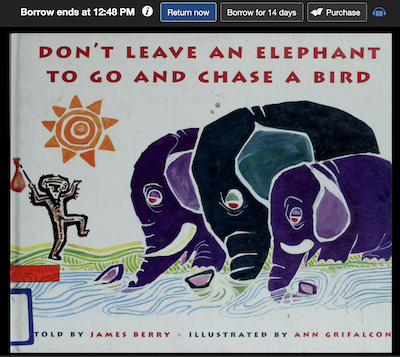
You might remember Berry's book from the African folktales project: Don't Leave an Elephant to Go and Chase a Bird, which is based on an Anansi story from Ghana.


James Berry was one of the most renowned Caribbean-born writers in England. Born in Jamaica in 1924, he emigrated to England in the 1940s, and went on to become a leading figure in the Caribbean Artists Movement. You can read more about his life and career at Wikipedia.

In this book, Berry has retold 20 Anansi stories in his brilliant, inimitable prose style. Here's a list of the titles linked to the Internet Archive: Anancy and Looking for a Wife / Anancy, Old Witch and King-Daughter / Anancy and the Making of the Bro Title / Anancy, Dog and Old Higue Dry-Skull / Monkey, Tiger and the Magic Trials / Tiger and Anancy Meet for War / Anancy and Friend / Anancy and the Hide-Away Garden / Tiger and the Stump-a-Foot Celebration Dance / Mrs. Anancy, Chicken Soup, and Anancy / Ratbat and Tacooma's Tree / Bro Tiger Goes Dead / Anancy Runs into Tiger's Trouble / Mrs. Dog First-Child and Monkey-Mother / Anancy and Storm and the Reverend Man-Cow / Anancy and Dog and Puss and Friendship / Anancy and Bad News to Cow-Mother / Mrs. Puss, Dog and Thieves / Anancy, Tiger, and the Shine-Dancer-Shine / Anancy, Lion and Tiger's Last Day.

The wonderful illustrations are by British-Nigerian artist Joseph Olubo:


Berry also published this Anansi children's book: First Palm Trees: An Anancy Spiderman Story.


This book has color illustrations by Greg Couch:


Berry is best known as a poet, and you can find many of Berry's other books at the Internet Archive too, including this book of children's poetry: A Nest Full of Stars..... which has illustrations by the late, great Ashley Bryan! You'll recognize his very distinctive style here, and for more about Bryan, see this post from just after his death earlier this month: 


So, for Anancy and more by James Berry, the Internet Archive awaits you:


Sunday, February 6, 2022

African Diaspora at Internet Archive: Ashley Bryan

I learned yesterday about the passing of the great Ashley Bryan. He was 98 and had lived a beautiful life, but it is sad to realize we are now living in a world without him. You can find out more about Ashley Bryan and his remarkable career at NPR and other news sources.

I've written about many African folktale, proverb, and riddle books by Ashley Bryan at this blog (see links and book covers below), and today I want to write about four of his African American books, inspired by traditional spirituals. You'll find links to the books and also to the individual songs below:


And in addition to this wonderful African American books, here are some African folklore books written and/or illustrated by Ashley Bryan, all just a click away at the Internet Archive.


by Won-Ldy Paye and Margaret Lippert
illustrated by Ashley Bryan
.


by Brian Swann
illusrated by Ashley Bryan


And here are today's books too:


Monday, January 24, 2022

Africa at the Internet Archive: Why Leopard Has Spots

New books are being added to the Internet Archive all the time, and I'm always excited when a new book of African folklore shows up, especially if it's one that I've been on the lookout for, like this one: Why Leopard Has Spots: Dan Stories From Liberia by Won-Ldy Paye and Margaret Lippert.


The reason I was looking for this one is that the illustrations are by Ashley Bryan, one of my favorite illustrators. You can find out more about his work in these previous posts. His style is instantly recognizable!


Won-Ldy Paye is a Dan storyteller from northeastern Liberia; his grandmother initiated him into the storytelling tradition, and he is also a drummer and dancer. You can find out more at his website, and you can also enjoy his work in the form of videos too! For example, here is The Bird that Ate the Bull.


Paye cowrote this book with Margaret Lippert, a folklorist and author who has collaborated with Paye on some other books also; they began working together in Seattle in the 1990s (Paye is now based in Connecticut). Here are three other books available at Internet Archive: The Talking Vegetables, Mrs. Chicken and the Hungry Crocodile (stories which both appear in the Leopard book) and Head, Body, Legs. These three books are all illustrated by Julie Paschkis; you can find out more at her website.


So, enjoy all the illustrations and the stories too... plus the videos! There's a great world of stories awaiting you online. :-)


Friday, November 19, 2021

Africa at the Internet Archive: In the Shadow of the Bush

Finishing up another week of public domain African folktales at the Internet Archive, I chose a book that gives me an excuse to write about one of my favorite children's book authors and artists, Ashley Bryan. So, today's book is: In the Shadow of the Bush by P. Amaury Talbot, published in 1912; it contains folktales of the Ekoi people of Nigeria:


The Ekoi live in southeastern Nigeria, where Talbot was a British colonial admistrator from 1902 until 1931. You can find out more about the Ekoi people at Wikipedia, and here is a list of the Ekoi folktales in the book, linked to the specific pages of Talbot's book: How All Stories and All History Came Among Me / How the First Rain Came / How the Moon First Came Into the Sky / How All the Stars Came / How the Two Biggest Stars Came Into the Sky / How the Sun Came Into the Sky / How Sun and Moon Went Up to the Sky / Why the Sunset Is Sometimes Red and Stormy / How All the Rivers First Came on Earth / How the Lame Boy Brought Fire From Heaven / Oporopootop / How Palm Trees and Water Came on Earth / How Pythons Lost Hands and Feet / Why Snake Has Neither Hands Nor Feet / Why Lizard's Head Is Always Moving Up and Down / How the Tortoise Got the Cracks and Bumps on His Back / Why There Are No More Lions in the Bush / Why Bush Fowl Always Calls Up the Dawn / Why Frog and Snake Never Play Together / How the First Hippopotami Came / How Black and White Men Came on Earth / The Treasure House in the Bush / Why the Other Members Must Serve Belly / How Human Beings Got Knee-caps / Hair's Revenge.

The wonderful story about Why Frog and Snake Never Play Together provided the inspiration for one of Ashley Bryan's stories in this collection of African folktales which he retold and illustrated: Beat the Story-Drum, Pum-Pum, just a click away at the Internet Archive.


Bryan takes the very brief version of the story reported in Talbot and elaborates on it with abundant detail, really bringing the friendship of the young frog and the young snake to life, as you can see by comparing the two versions. Plus, of course, the story has some of Bryan's wonderful and very distinctive artwork; here are the frog and the snake playing:


There are five stories in Bryan's book from a variety of sources, and the book makes for wonderful reading; highly recommended! You can find out more about Bryan and his work in this previous post:  The Dancing Granny.

Another book that I've written at this blog is Maria Leach's book of creation stories, and she also includes an Ekoi story there; here's the book, which you can find at Internet Archive: The Beginning: Creation Myths around the World. 


And the Ekoi story that she includes is "Obassi Osaw and Obassi Nsi" on p. 138:


You can compare her retelling with her source material in Talbot's book, which in addition to the folktales listed above contains a variety of legendary and mythological material throughout the book, including many references to these gods, as you can see from the search results:


Public domain books are ready and waiting for all kinds of reuse as Bryan and Leach have shown with their books. Maybe you too will be inspired by these stories from the Ekoi people of Nigeria:

by P. Amaury Talbot


by Ashley Bryan