Showing posts with label Author: Aardema. Show all posts

Tuesday, September 6, 2022

ABC 18: Rabbit Makes a Monkey of Lion

Because I'm out of town for about half of this month, our Anansi Book Club schedule is a little different. We're just reading three books this month, and it's already time for our second book (see the September schedule... plus you can see all the Anansi Book Club posts at this blog) — and I'm so excited about this new book because it has art by......... Jerry Pinkney! The book is Rabbit Makes a Monkey of Lion: A Swahili Tale by Verna Aardema, and it's just a click away at the Internet Archive!


I've written a lot about both the prolific author Verna Aardema (whose main focus was African folktales) and the amazing artist Jerry Pinkney at this blog; you can find all their posts with these links: Verna Aardema and Jerry Pinkney. They also collaborated on a fabulous book of riddles: Ji-nongo-nongo Means Riddles, which you can also find at Internet Archive!


The main characters as you can guess from the title are Rabbit and Lion, but Rabbit also has partners in crime. Here's Rabbit and Bush-Rat:


And here's Rabbit and Tortoise. Yes, that's right: you get two tricksters in this book. Both Rabbit and Tortoise are part of the story!


I'll have more to say in the next few days about Aardema's source for this story, and also about the folklore associated with the honeyguide bird, who is another important character in the tale. 

The source for the main part of this story is "The Hare and the Lion” in Bateman's Zanzibar Tales, and that happens to be one of the stories I included in the Reader's Guide Anthology. That book has illustrations by Walter Bobbett, but of course they are nothing to compare to Pinkney's artwork. Here's Bobbett's lion; as you can see in the caption, Bateman uses the Swahili names for the animal characters, so the rabbit is Soongoora (Sungura), the lion is Simba, the rat is Bookoo, and so on.


You can also read the Swahili version of the story that Bateman started from in Steere's Swahili Tales: Sungura na Simba / The Hare and the Lion (click on the image for a larger view):


It is always fascinating to be able to compare the source(s) that a writer uses when they retell a folktale, and in this case you can see a wonderful character that Aardema added to this story: a honeyguide bird. Since the story involves honey, adding in this character makes perfect sense, and it resonates beautifully both with the ecology and also with folktale tradition, as the honeyguide bird is a character you can find in many African folktales! More about the honeyguide bird: Meet the Greater Honeyguide, the Bird That Understands Humans.


You can also read about the honeyguide bird at Wikipedia. Here is how Jerry Pinkney draws the bird as a character in the story:


And of course this post would not be complete without a link to Jerry Pinkney's brilliant illustrations (include some amazing two-page color spreads) for Julius Lester's monumental adaptation of Joel Chandler Harris's stories, stripping out all the repugnant Uncle Remus frametale, rendering the rabbit in wonderful, readable glory. You can read all about Lester and Pinkey's Brer Rabbit here, and yes, it's available at Internet Archive: The Complete Tales.


Here's one of those two-page color spreads: wow!


So, just jump in and enjoy Aardema's version of the story AND the illustrations. It's full of classic African folktale animals and trickster motifs, and just a click away at the Archive, thanks to the power of Controlled Digital Lending!

by Verna Aardema


Wednesday, October 20, 2021

Africa at the Internet Archive: Anansi again!

For today's western Africa post, I want to feature two more Anansi books, both by famous children's book authors that I've featured in earlier posts at this blog. The first is Verna Aardema, with her book Anansi Does the Impossible: An Ashanti Tale.


The story originally appeared in Aardema's book The Sky God Stories (also available at Internet Archive), and when that book went out of print and the rights reverted to Aardema, she republished this individual story with illustrations by Lisa Desimini. Here is Anansi preparing for the task of capturing Snake alive, for example:


I've featured MANY of Verna Aardema's African folktale books in previous posts, and you can see all those Aardema posts with this link.

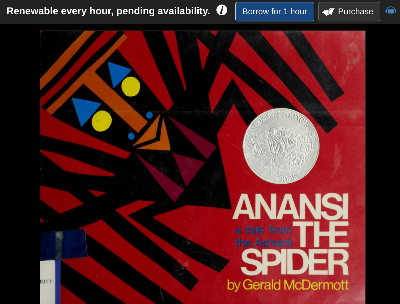
The other book I want to feature today is Gerald McDermott's Anansi the Spider: A Tale from the Ashanti.


Gerald McDermott wrote and illustrated children's books featuring folktales and mythology from around the world; you can find out more about his career and his mythological pursuits at Wikipedia. This book was his first, published in 1972, and it received a Caldecott Honor award. 

McDermott's style of storytelling is very spare, and the beautiful illustrations do a lot of the work here... and what's really fascinating is that the copy of the book at Internet Archive has annotations! Someone has pasted in their own additions to the story right there in the text, as you can see here for example when Anansi emerges from inside a fish: "Out came Anansi, all wet and wobbly."


You can also see more of McDermott's books at Internet Archive. I featured McDermott's book about the African trickster rabbit in an earlier post: Zomo the Rabbit: A Trickster Tale from West Africa.


I am a fan of all the trickster, but especially Rabbit, since it was my fascinating with African American Brer Rabbit stories that led me to begin this African folktale project to begin with. So, both Rabbit and Spider await you at Internet Archive!


by Gerald McDermott


by Verna Aardema


Sunday, October 10, 2021

Africa at the Internet Archive: Misoso: Once Upon a Time Tales

I had so much fun doing epics and proverbs over the past two weeks, but I'm also excited to get back to folktales this week, and I'll be featuring anthologies of African stories (and then I'll jump back into region-specific collections).

I'll start this week with one of the mainstay authors of African folktales for young readers, Verna Aardema, and this anthology: Misoso: Once Upon a Time Tales from Africa.


The book contains twelve stories, with illustrations by Reynold Ruffins, a great American painter and illustrator born in 1930; he died just this past summer at the age of 91. You can find out more about his work and career at Wikipedia. There is an obituary here: Artist Reynold Ruffins Died Sunday at Age 91, which includes this photo:


Here, for example, is Ruffins' illustration for the story Half-a-Ball-of-Kenki:


Some of the stories that you will find in this book have been published as individual books with different illustrators, which gives you a chance to compare illustrations, like this version of the Kenki story illustrated by Diane Stanley Zuromskis.

by Verna Aardema


The Kenki story is from an Ashanti source, and Aardema provides bibliography in the back of the book... plus, with the resources of the Internet Archive you can look up Aardema's sources and compare her versions with the traditional stories. For example, Rattray's book of Ashanti folktales is available at Internet Archive, and not only does it contain the Kenki story, it also contains an illustration by an (unnamed) Ashanti artist; more about that here. 


I still have not posted about all of Verna Aardema's books of African stories, but I have posted about a lot of them; you can see all those posts here: books by Verna Aardema, including today's lovely book: 

Thursday, September 16, 2021

African Folktales at Internet Archive: Bringing the Rain to Kapiti Plain

For another story from eastern Africa, here is the ever-prolific Verna Aardema again, and her book, Bringing the Rain to Kapiti Plain, just a click away at Internet Archive:


This book is of special interest to me because it is a chain tale, which is my own favorite folktale genre, and it is also one which is very popular in Africa; I think it's safe to say that you will find more chain tales in African folktale than anywhere else in the world, with chain tales in India running a close second. What is a chain tale? There are different varieties, but you can get the idea from the English fairy tale "The House That Jack Built" or the English song "The Old Lady Who Swallowed a Fly."

In this children's book, the chain is about the actors and actions it takes to bring water to Kapiti Plain, where there is a drought. The Kapiti plains are located in Kenya, and this folktale is one told by the Nandi people of Kenya. For her source, Aardema used this book, which is also available at Internet Archive: The Nandi, Their Language and Folklore by A. C. Hollis, published in 1909. 


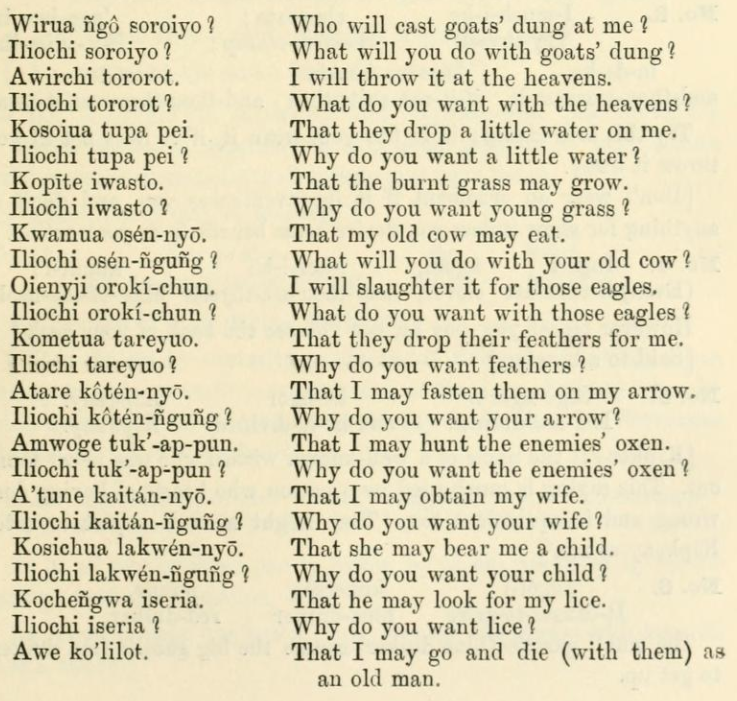
Aardema changed the story in big ways to turn it into a children's book; you can read the story Hollis collected in both Nandi and his English translation:


Comparing the story that Aardema began with and the story that she finally wrote is a great way to get new insight into both stories.

The illustrations in this book are by Beatriz Vidal, and they add to the pleasure of the story and the storytelling:


You can find out more about Vidal and her beautiful work at her website. This book was her very first publication, and she has gone on to illustrate many more wonderful children's books.

Aardema's most famous book is also an example of a chain tale: Why Mosquitoes Buzz in People's Ears: A West African Tale, available at Internet Archive:


And I've also blogged about this children's chain tale book: Congo Boy: An African Folk Tale by Mollie Clarke, also at Internet Archive:


Plus for a more authentic chain tale, not one retold for children, check out the title story of Fourteen Hundred Cowries and Other African Tales by Abayomi Fuja at Internet Archive:


One of these days I want to write an anthology of chain tales from around the world; it's a project I worked on a few years ago but I realized I was in trouble because I did not have the knowledge to complete the Africa part of the project... now I am ready to provide good coverage of African chain tale stories! Here's my chain tale collection if you are curious; it has a strong emphasis on stories from India, along with other parts of the world.

And now, if you are ready for some chain tale pleasure, here is today's book, just a click away at Internet Archive:

by Verna Aardema


Monday, August 16, 2021

African Folktales at Internet Archive: Akan-Ashanti Folk-Tales

Yesterday I featured two important works of contemporary scholarship from the World Oral Literature Project, and today I want to feature an older, very important collection: Akan-Ashanti Folk-Tales by R. S. Rattray, which contains 75 stories:


This book was published in 1930, so it will be entering the public domain soon, and for now, it's just a click away at the Internet Archive. Some of Rattray's earlier work is in the public domain, such as his collection of Ashanti Proverbs, which I've written about earlier at this blog. You can find out more about Rattray at Wikipedia.

In the introduction to this collection of tales, Rattray is highly critical of earlier tale collections for their amateurish approach: "The most that can be said for such methods is that the results are perhaps better than nothing at all." With this book, Rattray aspires to a close, literal translation of the stories that he heard from old storytellers in remote villages. 

The book has illustrations by members of the Ashanti, Fanti, and Ewe tribes with whom Rattray lived and worked but, sad to say, Rattray did not record the names of the artists. Some of the illustrations are really marvelous, like this one of Half-a-Ball-of-Kenki:


This illustration shows a woman on her way to her village:


Rattray's book has been important source for later book authors: Verna Aardema's books The Sky-God Stories, Anansi Finds a Fool, and Half-a-Ball-of-Kenki  rely on Rattray's book as a source, as does Ashley Bryan's The Adventures of Aku.


by Verna Aardema


by Verna Aardema


by Verna Aardema


by Ashley Bryan


So, you can enjoy Rattray's abundant collection of stories, or look at the books which those stories inspired; they are all available at the Internet Archive.

by R. S. Rattray


Friday, August 13, 2021

African Folktales at Internet Archive: Ji-nongo-nongo Means Riddles

I'm finishing up this week with another book illustrated by Jerry Pinkney, and this time it's a book of riddles collected by Verna Aardema: Ji-nongo-nongo Means Riddles, which is just a click away at the Internet Archive.


You can use these links to see previous posts about both the author Verna Aardema and the illustrator Jerry Pinkney. 

Riddles and proverbs are an incredibly important part of the African folk tradition, and I shared a book of riddles earlier this summer: The House with No Door: African Riddle Poems by Brian Swann with illustrations by Ashley Bryan. This book draws on riddle traditions from across Africa, with forty riddles as found in about a dozen different tribal traditions; you can find information about the sources used in the credits section at the front of the book. The title comes from the Kimbundu language of Angola, and refers to a traditional Angolan guessing game.

Lots of the riddles have to do with animals, just as so many proverbs are also about animals, and these riddles often have a proverbial value to them. For example:
Who has a house too small for guests?
The answer is..... the tortoise. This Yoruba riddle plays with the physical fact of the tortoise's shell, but it also resonates with the greedy selfishness of the trickster tortoise in Yoruba culture; being hospitable is not one of the tortoise's qualities. And if the tortoise does invite you to dinner, you better be careful!

The illustrations are in Pinkney's beautiful, distinctive style; here's a page that accompanies some of the animal riddles:


And one of my favorite proverbs in the book gets its own full-page illustration:
What can the buffalo do that two strong men can not? 
I'll put the picture here so that you can think about it; the picture gives you a clue, and you'll find the answer below the picture.


The answer: Grow horns!

And here's another one with a nice proverbial quality to it:
What is it that even the ostrich with its long neck and sharp eyes cannot see?
Again, I'll put the answer down below the illustration so you can ponder...


The answer: The future!

So, that seems like a fitting phrase to use here at the end of this week's recommendations, but I'll be back next week with more. Meanwhile, enjoy all the riddles here, and the gorgeous illustrations:

with illustrations by Jerry Pinkney


Monday, August 9, 2021

African Folktales at Internet Archive: Who's in Rabbit's House?

I featured a book by Verna Aardema with artwork by Diane and Leo Dillon yesterday — Behind the Back of the Mountain: Black Folktales from Southern Africa — and I've got another book of their today: Who's in Rabbit's House? A Masai Tale... just a click away at Internet Archive.


What the Dillons did for the illustrations is really ingenious: they have re-imagined the story as a tale told by people in a Maasai village, wearing masks for the different characters. The story opens in the village as people assemble for the performance:


Then the performers put on their masks:


The story is narrated at the top of the page, with the action being shown below:


It's quite exceptional; I haven't seen anything quite like this before in the children's books that I've reviewed so far this summer. Beautiful, and something you can study in close detail, and also a great topic of conversation if you are reading the book with a child.

This story originally appeared in one of Verna Aardema's earlier story collections: Tales for the Third Ear from Equatorial Africa, where it was titled "The Long One." That book is also available at Internet Archive; it contains nine stories, with art by Ib Ohlsson, a Danish artist who is probably best known for his illustrations in the "Encyclopedia Brown" series.


Here are his illustrations for the story; it's very charming, but nothing to compare to the creative interpretation by the Dillons IMO.


Meanwhile, Aardema's source for the story is a book I featured in an earlier post: 


Here's that story: The Caterpillar and the Wild Animals. This is how it begins:


So, that is today's book with artwork by the amazing Dillons, and I'll be back with another book illustrated by the Dillons tomorrow. Meanwhile, enjoy!