Showing posts with label IAAW18. Show all posts

Friday, September 17, 2021

African Folktales at Internet Archive: Tololwa Mollel (II)

Finishing up this week of stories from eastern Africa (see all the posts on one page), I am excited to share two more beautiful books by Tololwa Mollel: a Maasai legend called The Orphan Boy, and an Akamba legend, The Princess Who Lost Her Hair; both books are just a click away at the Internet Archive.


Tololwa Mollel is an Arusha Maasai, now living in Canada, but he spent his childhood in Tanzania on his grandfather's coffee farm near Mount Kilimanjaro. The Orphan Boy is inspired by one of his grandfather's stories, and the illustrator, Paul Morin, traveled to Maasai country to do research for the illustrations, and they are really beautiful:


The Princess Who Lost Her Hair is a story told by the Akamba people who live in Kenya just below Mount Kenya. The gorgeous illustrations for this book are by Charles Reasoner:


You might recognize Reasoner's style from the book that I featured in the first blog post for this week: Warrior Son of a Warrior Son, by Melinda Lilly; here's a link to all the books so far with Reasoner's illustrations.


I've written about Mollel's work previously; this links to a blog post with information about four other books he has written based on African legends: Ananse's Feast: An Ashanti Tale; The Flying Tortoise: An Igbo Tale; The King and the Tortoise; Rhinos for Lunch, and Elephants for Supper: A Maasai Tale, all of which are available at Internet Archive. You can find out more about his wonderful work at his website: TololwaMollel.com.


So, enjoy: you've got a half-dozen wonderful books here which share the stories both of eastern Africa along with stories from western Africa also, all just a click away at Internet Archive.

Thursday, September 16, 2021

African Folktales at Internet Archive: Bringing the Rain to Kapiti Plain

For another story from eastern Africa, here is the ever-prolific Verna Aardema again, and her book, Bringing the Rain to Kapiti Plain, just a click away at Internet Archive:


This book is of special interest to me because it is a chain tale, which is my own favorite folktale genre, and it is also one which is very popular in Africa; I think it's safe to say that you will find more chain tales in African folktale than anywhere else in the world, with chain tales in India running a close second. What is a chain tale? There are different varieties, but you can get the idea from the English fairy tale "The House That Jack Built" or the English song "The Old Lady Who Swallowed a Fly."

In this children's book, the chain is about the actors and actions it takes to bring water to Kapiti Plain, where there is a drought. The Kapiti plains are located in Kenya, and this folktale is one told by the Nandi people of Kenya. For her source, Aardema used this book, which is also available at Internet Archive: The Nandi, Their Language and Folklore by A. C. Hollis, published in 1909. 


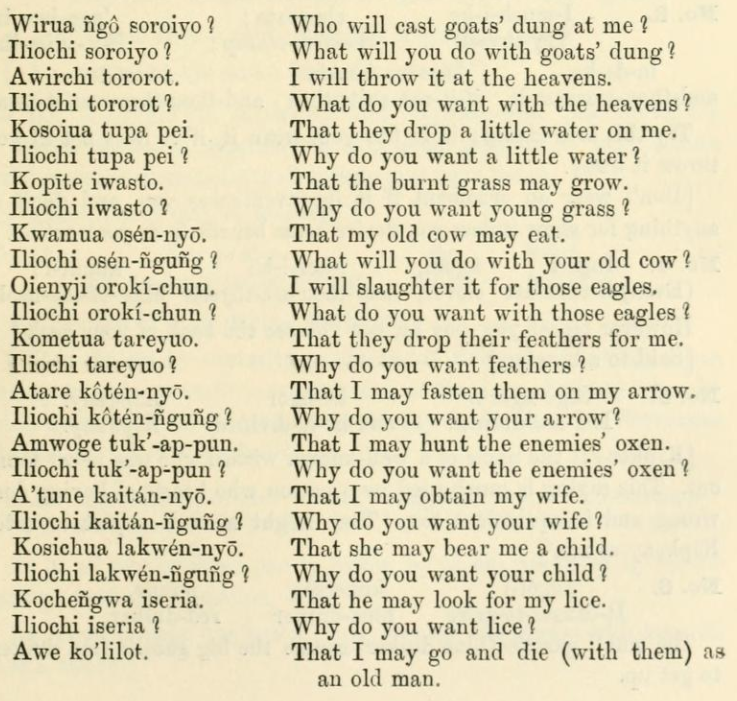
Aardema changed the story in big ways to turn it into a children's book; you can read the story Hollis collected in both Nandi and his English translation:


Comparing the story that Aardema began with and the story that she finally wrote is a great way to get new insight into both stories.

The illustrations in this book are by Beatriz Vidal, and they add to the pleasure of the story and the storytelling:


You can find out more about Vidal and her beautiful work at her website. This book was her very first publication, and she has gone on to illustrate many more wonderful children's books.

Aardema's most famous book is also an example of a chain tale: Why Mosquitoes Buzz in People's Ears: A West African Tale, available at Internet Archive:


And I've also blogged about this children's chain tale book: Congo Boy: An African Folk Tale by Mollie Clarke, also at Internet Archive:


Plus for a more authentic chain tale, not one retold for children, check out the title story of Fourteen Hundred Cowries and Other African Tales by Abayomi Fuja at Internet Archive:


One of these days I want to write an anthology of chain tales from around the world; it's a project I worked on a few years ago but I realized I was in trouble because I did not have the knowledge to complete the Africa part of the project... now I am ready to provide good coverage of African chain tale stories! Here's my chain tale collection if you are curious; it has a strong emphasis on stories from India, along with other parts of the world.

And now, if you are ready for some chain tale pleasure, here is today's book, just a click away at Internet Archive:

by Verna Aardema


Wednesday, September 15, 2021

African Folktales at Internet Archive: The Lion's Whiskers

Continuing with the eastern Africa theme this week, here is a collection of stories from Ethiopia: The Lion's Whiskers and Other Ethiopian Tales by Russell Davis and Brent Ashabranner.


The authors collected the stories when they were employed by the Ethiopian Ministry of Education working with the major different ethnic groups: Amhara, Oromo (Galla), Tigray, Somali, Beta Israel (Falasha), and others. 

The wonderful illustrations are by Helen Siegl; here is the illustration for the story of the Hyena-Man:


You can find out more about Helen Siegl at her website (the website is still there, although she died in 2009), and you might remember her from an earlier post here: The Dancing Palm Tree and Other Nigerian Folktales.


The book has an odd publication history; it was published in 1959 with 31 stories, and then was reissued again in 1997, but with only 16 stories, the ones that the surviving author, Brent Ashabranner, thought had the widest appeal. I am pleased to say that BOTH editions are available at Internet Archive; here's a link to the older, more complete 1959 edition, which has a slightly different title: The Lion's Whiskers; Tales of High Africa. 


This edition has illustrations by James Teason in a quite different, more straightforward style; here is his illustration of the Hyena-Man story:


So, I'll recommend the 1997 edition for the beautiful illustrations, but I'll recommend the 1959 edition for more stories, and they are both just a click away at the Internet Archive:


by Russell Davis and Brent Ashabranner


by Russell Davis and Brent Ashabranner


Tuesday, September 14, 2021

African Folktales at Internet Archive: Myths and Legends of the Maasai

Continuing on with the theme of stories from eastern Africa this week (see all this week's posts on one page), here is a collection of stories from the Maasai people of Kenya and Tanzania: Inkishu: Myths and Legends of the Maasai by Kioi wa Mbugua, a book published in 1994 in Nairobi, Kenya, and now just a click away at Internet Archive.


With funding from OXFAM International, the author visited Maasailand (specifically the Narok district of Kenya) to collect these stories from a traditional Maasai storyteller named Ole Parkisua. Although the author worked with a traditional storyteller, the text of the book is in conventional English; it doesn't try to convey the sense of oral tradition but instead retells the stories in literary English.

The word "Inkishu" in the Maa language means "cattle," and the stories in the book feature what the author calls the three essentials of Maasai life: their God, their land, and their cattle. The Maasai call themselves "Iltung 'ana loo Nkishu," People of the Cattle.

The book includes poems by Goro wa Kamau, and photographs taken by Adrian Arbib, along with art by different artists for each of the stories (the artists are credited in the table of contents). This is the artwork by Samwel Ngoje for the story called "Forest of the Lost Child."


This is artwork by Kahare Miamo for the story of "The Sacred Mountain."


It's not a long book, just 84 pages, so if you are looking for an introduction to some Maasai cultural traditions and stories, this is a fine book to read!

by Kioi wa Mbugua


Monday, September 13, 2021

African Folktales at Internet Archive: The Ogress and the Snake

For today's book of stories from eastern Africa, I'm really excited to return to an author I've written about before at this blog: Elizabeth Laird, and her book The Ogress and the Snake, and Other Stories from Somalia, which is just a click away at Internet Archive:


There are eight stories in the book: The Ogress and the Snake, How the Cat Became Woman's Friend, How the Dog Became Man's Friend, Deya Ali and the Thieves, The Sun and the Raven, The Good Prince, Slippery Hirsi and Crooked Kabaalaf, and The Miraculous Head. And see below for MANY more stories...

As the author explains in the introduction, she first visited Somalia in the late 1960s. Then, thirty years later, she returned to Visit the Somali region of Ethiopia, and she collected stories in the town of Jigjiga. She talked with many storytellers there, whom she writes about in the Introduction. The title story of the book, for example, she learned from Ikran, the daughter of a woman named Hukun Hussein Fura... and see below for more stories by these same narrators!

The illustrations are by Shelley Fowles (an artist from South Africa who now lives in the United Kingdom), and they are very charming, as you can see:


You can find out more about Elizabeth Laird's career at this British Council webpage: Elizabeth Laird, and she also has a website: Elizabethlaird.co.uk. 


I was also very pleased to learn that she is at Twitter: @EMRLaird.

Here is the book of hers that I featured previously at this blog: When the World Began: Stories Collected in Ethiopia.


And amazingly, while writing this post, I learned that in addition to the stories in that book, Laird has published online all 300 of the stories that she collected in Ethiopia, with both the English and Amharic versions available here: Ethiopian Folktales. That website includes additional stories from Somalia:


Just click the flag to change to the Amharic presentation:


You will recognize many of the same storytellers in that list there, with many more of their stories to read! Here is a picture from the website of Laird collecting stories from a group of midwives in Somalia:


In addition, I also learned that she has written a book about her experiences collecting stories in Ethiopia, and it is available at Internet Archive also: The Lure of the Honey Bird: The Storytellers of Ethiopia.


So, ENJOY! Not only are there lovely stories available in this book at Internet Archive, you can also find even more stories to read at Laird's website.

by Elizabeth Laird


Sunday, September 12, 2021

African Folktales at Internet Archive: Warrior Son of a Warrior Son

For Week 18, I want to switch back to doing a post with a regional focus, this time looking at stories from eastern Africa, starting with this children's book inspired by a Maasai story from Kenya: Warrior Son of a Warrior Son: A Masai Tale retold by Melinda Lilly, just a click away at Internet Archive:


In this book Lilly has collaborated again with Charles Reasoner as the illustrator, and the illustrations are gorgeous; here are two of his 2-page spreads:


Lilly's book is inspired by a folktale collected by Hollis and published in his book about the Maasai: The Masai: Their Language and Folklore. You can see the story of "The Caterpillar and the Wild Animals" both an interlinear version with the Maasai translated word for word into English, and then also a stand-alone English version with more standard English word order and phrasing.


Having access to the Maasai version allows you to compare in detail the choices that both Lilly and then Reasoner made as they created their own version of the story. Lilly stays close to the Maasai version in some ways, like including the Maa names of the animals along with some other distinctive phrases. At the same time, she changes the story in some important ways, like including a lovely frame of a grandmother telling a story to her granddaughter (see illustration above), and also adding an important twist at the end of the story which connects back to the theme of the grandmother and granddaughter, but *spoilers* I'm not going to say what that twist is here. :-)

And for more comparative fun (that's why I love studying folktales: it's all about comparing different versions), you can look at another book inspired by this same story, which I've blogged about before: Who's in Rabbit's House? by Verna Aardema, with illustrations by Diane and Leo Dillon.


Aardema chose a very different frame for her version of the story: a performance of the story in a Maasai village by actors wearing masks. That choice, in turn, prompted the beautiful illustrations done by the Dillons showing human performers wearing animal masks:


Of course I also have to mention the other wonderful books by the team of Lilly and Reasoner which I have blogged about earlier:


So, if you have some time, these beautiful children's books are all waiting for you to explore at Internet Archive, along with primary source material like Hollis's book of Maasai stories with the Maa language text. All just a click away!

by Melinda Lilly