Showing posts with label IAAW22. Show all posts

Friday, October 15, 2021

Africa at the Internet Archive: Bury My Bones

I've been writing about anthologies of African folktales this week, and the anthology I want to feature today is a book published in 1994: Bury My Bones But Keep My Words: African Tales for Retelling by Tony Fairman, and it's just a click away at the Internet Archive.


As you can see from the table of contents, the stories come from across Africa, and Fairman provides information about his sources in the bibliography; some of the stories are adapted from previous publications while others are stories that Fairman himself heard from African storytellers:


As you can tell from the book's subtitle, "African tales for retelling," Fairman intends this book especially for use in schools, and he includes notes for teachers in how to help students engage in their own storytelling activities. That was the practice I always used in my mythology and folklore classes (instead of writing essays, students wrote stories inspired by the reading we did in class), and I can endorse it highly: one of the best ways to learn about a story is to think about how you would retell it in your own way. And you don't have to be a student in school to practice retelling stories; it's something we can all do... and we all should do, as Fairman explains here in the Introduction to the book:


The illustrations are by Meshack Asare, who is in turn an award-winning children's book author and illustrator from Ghana. You can find out more about his work at Wikipedia, and also in this profile of Neustadt prize-winners in children's literature: NSK Neustadt Prize Laureate Meshack Asare, and you can listen to an interview with him at the KGOU radio station recorded after his Neustadt award.


The illustrations Asare did for this book really add to the drama of the story as you can see:


One of Asare's books is available at Internet Archive too! It's not folklore, but is a book that might be of interest to readers of this blog: the book is Sosu's Call and it is the Winner of the 1999 UNESCO prize and IBBY's Outstanding Books for Young People with Disabilities award. The story is about a boy who cannot walk, yet he is the one who saves the people of his village when disaster is about to strike. 


So, if you are in the mood for folktales (I am always in the mood for folktales), you can check out Tony Fairman's book with illustrations by Meshack Asare... and if you are in the mood for a contemporary story with a powerful message, Meshack Asare's own book awaits you, both just a click away at Internet Archive!

by Tony Fairman


Thursday, October 14, 2021

Africa at the Internet Archive: Plays from African Tales

For today's anthologies, I have something a bit different: these are both books of tiny plays that are inspired by African folktales, intended for theatrical performance or to use for reader's theater. 

The first book is Barbara Winther's Plays from African Tales, which contains 18 different small plays based on African folktales, with notes and background for each of the plays, plus production notes (approximate performance time, cast of characters, props needed, etc.). If you are a teacher and want to stage a performance, the plays are royalty-free for school use!


These are the plays included in the book: Anansi, the African Spider (3 plays); Ijapa, the Tortoise (2 plays); Two Dilemma Tales, African Trio; The Monkey Without a Tail; Bata's Lessons; Trickster Hare's Feast; The Great Tug of War; Mantis, the Dreamer; Two From Abu Nuwas; Who Wears the Necklace Now? 

The script formatting is very simple and makes for fun reading even if you are not interested in staging a performance. 


The other book is an anthology of plays from different parts of the world, including four plays based on African folktales: The Reader's Theatre of Folklore Plays: African, Asian, and Latin-American Stories by Henry Gilfond.


The four African plays included are: Three Foolish Men (Tanzania), You've Got to Use Your Head (Kenya), Who's Nervous? (Congo), and Mind and Matter (Ethiopian).

Unlike Winther's book, this book has illustrations; they're by Jim Roldan. Like Winther's book, the stories here are fun to read silently, in addition to being scripted for performance (since this is a reader's theater book, it does not have production notes as Winther's book does).


So, especially if you are a teacher, you might find these books useful both as texts for performance in your classes, or as an inspiration for you and your students to write your own scripts inspired by traditional folktales... which you can find in abundance at the Internet Archive of course!

by Barbara Winther


by Henry Gilfond


Wednesday, October 13, 2021

Africa at the Internet Archive: Dianne Stewart

Yesterday I wrote about Phyllis Savory and her books of folktales from southern Africa, and that inspired me to write today about Diane Stewart, another prolific South African author of folktale collections (more at her website). The Internet Archive does not have a lot of her folktale books, but they do have two of them, so that's what I'll write about today, starting with Folktales from Africa, just a click away at the Internet Archive.


This book contains 20 stories, and there is a bibliography of sources in the back. The illustrations are by Marjorie van Heerden, and they are one of the nicest features of this book: very lavish color art, including two-page spreads as you can see here for the table of contents: I really like how the animals want to see the book the child is reading: very meta- and very cute!


And here's an informative map at the start of the book; once again van Heerden has incorporated a person into the illustration in a way that is really charming and engaging, as opposed to the map just sitting on the page by itself:


And look at this lively encounter between a person and an elephant:


Van Heerden is a South African author and illustrator; you can find out more at her website. I am really glad to have learned about her work from this book!


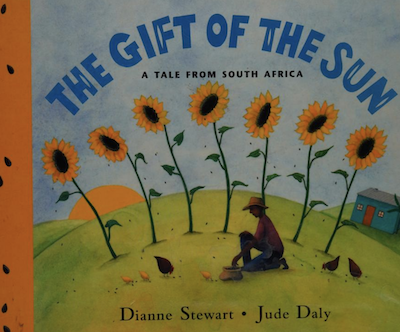
The other book is a very sweet version of a traditional "air castle" folktale: The Gift of the Sun


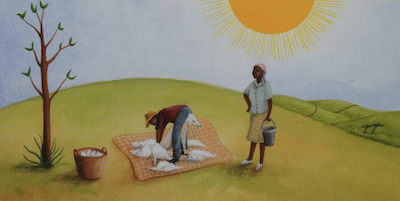
In most "air castle" stories someone is having a fantasy about the things they will do to become rich step by step, but it's just a fantasy. In this book, step by step, the characters really do get a happy ending, but it starts with trading-down instead of trading-up. The illustrations for this book are by Jude Daly:


So, I'll keep an eye out to see if more Dianne Stewart books show up at the Internet Archive in future, but for now these are two fine books to start with!


by Dianne Stewart


by Dianne Stewart


Tuesday, October 12, 2021

Africa at the Internet Archive: Phyllis Savory

Since I started off this week with two prolific storytellers (Verna Aardema and Ashley Bryan), I thought I would carry on with another familiar author from this blog: Phyllis Savory, and this anthology of stories from her other books, The Best of African Folklore, just a click away at Internet Archive


The book contains 39 stories selected from Phyllis Savory's long list of African folktale collections. There is not a bibliography that matches up the individual stories with the previous books, but there is a note at the start of each story indicating the cultural tradition from which the story comes. 

The lovely illustrations are by Gina Daniel:


Phyllis Savory has published a wide-ranging series of African folktale books, focusing mostly on southern Africa, but including other African traditions as well, especially central and eastern Africa. Here are other Phyllis Savory books that you can find at Internet Archive:


I think those are all the Phyllis Savory books at Internet Archive so far... but they are adding new books every day, so maybe some more books by Phyllis Savory will arrive. I'll be sure to post them if they do! :-)

Monday, October 11, 2021

Africa at the Internet Archive: African Tales, Uh-Huh

For today's post, I want to return to one of my all-time favorite book illustrators and authors, Ashley Bryan, and this anthology of his work: African Tales, Uh-Huh, just a click away at Internet Archive.


This is a big book (over 200 pages) that contains stories originally published in some of Bryan's earlier publications, all of which are also available at the Internet Archive: The Ox of the Wonderful Horns, Beat the Story-Drum Pum-Pum, and The Lion and the Ostrich Chicks, with further details in the source notes you will find at the back of the book. I've written about these and other books by Bryan in previous posts.

You will probably recognize Bryan's distinctive style here if you have read any of his other books; there are both black-and-white and color illustrations, as you can see in this two-page spread:


If you look closely, you can see how he sometimes weaves words into the art, as in the space between the cat above and the hen and frog below here:


And he is also a master of bringing a sense of motion and sound to the scenes that he depicts as here:


I am such a fan of Ashley Bryan's work, and I am pleased to report that he still with us, 98 years old and doing well. You can find out more at the Ashley Bryan Center website


He was featured last month in this article in Columbia Magazine: Make Me Brave for Life, which features this photo, along with this wonderful quote from Nikki Giovanni, a friend of Bryan's:


So, get in touch with that creative spirit in you by communing with an Ashley Bryan book... and the Internet Archive is ready and waiting. :-)

by Ashley Bryan


Sunday, October 10, 2021

Africa at the Internet Archive: Misoso: Once Upon a Time Tales

I had so much fun doing epics and proverbs over the past two weeks, but I'm also excited to get back to folktales this week, and I'll be featuring anthologies of African stories (and then I'll jump back into region-specific collections).

I'll start this week with one of the mainstay authors of African folktales for young readers, Verna Aardema, and this anthology: Misoso: Once Upon a Time Tales from Africa.


The book contains twelve stories, with illustrations by Reynold Ruffins, a great American painter and illustrator born in 1930; he died just this past summer at the age of 91. You can find out more about his work and career at Wikipedia. There is an obituary here: Artist Reynold Ruffins Died Sunday at Age 91, which includes this photo:


Here, for example, is Ruffins' illustration for the story Half-a-Ball-of-Kenki:


Some of the stories that you will find in this book have been published as individual books with different illustrators, which gives you a chance to compare illustrations, like this version of the Kenki story illustrated by Diane Stanley Zuromskis.

by Verna Aardema


The Kenki story is from an Ashanti source, and Aardema provides bibliography in the back of the book... plus, with the resources of the Internet Archive you can look up Aardema's sources and compare her versions with the traditional stories. For example, Rattray's book of Ashanti folktales is available at Internet Archive, and not only does it contain the Kenki story, it also contains an illustration by an (unnamed) Ashanti artist; more about that here


I still have not posted about all of Verna Aardema's books of African stories, but I have posted about a lot of them; you can see all those posts here: books by Verna Aardema, including today's lovely book: