Showing posts with label IAAW12. Show all posts

Friday, August 6, 2021

African Folktales at Internet Archive: Animals Mourn for Da Leopard

Finishing up this week of story collections from western Africa, I chose this beautiful book: Animals Mourn for Da Leopard, and Other West African Tales by Peter Dorliae, just a click away at Internet Archive.


Peter Dorliae was a writer and folklorist from Liberia, and Chief of the Yarwin-Mehnsonoh district. The stories he tells here come specifically from the Mano people; you can read more at Wikipedia. They live primarily in Nimba county in the northeast of the country.


There are 10 stories in the book — Animals Mourn for Da Leopard; Mr. Spider Smokes Out the World's Hole; We Oppose President Stomach; The Monkey and the Snail; Farmer Zia, the Hard-luck Man; The City Mortician and Dr. Spider; Mr. Spider and the Death Eggs; Greedy Turtle and the Blue-wings; The Hated Dog Gban; Guinea Hen's Children — plus some proverbs too!

The illustrations are by Solomon Irein Wangboje, an artist from Nigeria. Here is his illustration for the title story about Leopard:


And here is Monkey challenging Snail to a race:


There are illustrations for all the stories which await you at the Internet Archive:

by Peter Dorliae


Thursday, August 5, 2021

African Folktales at Internet Archive: The Cow-Tail Switch

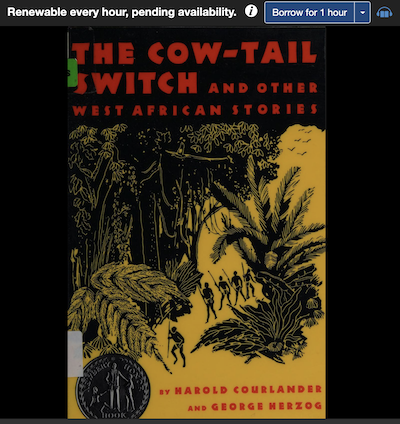
I knew I could not let this week of story collections from western Africa go by without a book by the great Harold Courlander, so here it is: The Cow-Tail Switch and Other West African Stories by Harold Courlander and George Herzog, just click away at the Internet Archive:


The title story is a dilemma tale, put into narrative form: a hunter, who had been killed by a leopard, was revived through the supernatural powers of his many sons. Now the father is going to give a beautiful switch made from a cow-tail to the son who most deserves it: would that be the one who found the tail that led to their father's body in the forest? the one who put the bones back together? the one who covered the bones with sinews and flesh? or the one who gave him the power of movement? the one who put blood back into the veins? the one who restored their father's breath? There is an ingenious answer to this question, which also yields a proverb... but I am not going to give it away here: you can snag the book from Internet Archive and see the answer for yourself.

As usual with Courlander's books, you will find helpful notes about each story in the back of the book. For example, the note explains that the cow-tail switch story is one of the tales that was collected in Liberia by Courlander's co-author, George Herzog, who was also an ethnomusicologist as was Courlander; more about Herzog at Wikipedia.

The illustrations are by Madye Lee Chastain, a children's book illustrator active in the 1940s and 1950s (this book was originally published in 1947). Here is her illustration of the sons going into the forest to look for their father (it's also the illustration on the cover of the book):


You might recognize Courlander's name from previous book recommendations; with this link you can access all the books by Courlander that I've written about so far, and there will be more to come!


by Harold Courlander and George Herzog


Wednesday, August 4, 2021

African Folktales at Internet Archive: Limba Stories and Storytelling

You might remember when I shared Ruth Finnegan's Oral Literature in Africa back in June, and I knew I would want to share her book of stories from Sierra Leone, which fits in perfectly with this week of stories from western Africa: Limba Stories and Storytelling. There are almost a hundred stories in here, plus riddles and proverbs too, all just a click away at the Internet Archive:


Finnegan recorded these stories in the early 1960s before it was feasible to do video recording, but her audio tape recordings have been digitized and put online as part of the World Oral Literature project, which means you can listen to them here: Ruth Finnegan: Limba Stories and Songs.


So, in addition to reading all the stories in Finnegan's book, you can get a sense of the oral performance by listening to the recordings from what is now sixty years ago in Sierra Leone. And Ruth Finnegan is still with us! You can read about her life and career at Wikipedia: Ruth Finnegan; she was born in Ireland in 1933, making her 87 years old... and she has a wonderful website also: RuthFinnegan.com.

You can read more about the Limba people at Wikipedia: Limba,  for fans of Anansi stories: there is a whole series of spider stories found in Chapter 3, stories about animals:


So, there is all kinds of goodness here: Finnegan's book is a work of serious scholarship written for an audience of anthropologists, but it also has wonderful stories here for you to read and enjoy!

by Ruth Finnegan


Tuesday, August 3, 2021

African Folktales at Internet Archive: The Pot of Wisdom

Carrying on with stories from western Africa (see all this week's posts on one page), I wanted to do a children's book today, so here it is: The Pot of Wisdom: Ananse Stories by Adwoa Badoe, ten wonderful Anansi stories just a click away at the Internet Archive. (Anansi is the more usual spelling in the Caribbean, while Ananse is more common in Africa.)


Adwoa Badoe was born and educated in Ghana; she now lives in Canada. The beautiful illustrations are by Baba Wagué Diakité, an artist from Mali. Here is his depiction of Ananse and the pots of food:


And here is Ananse and the birds:


These were stories that Adwoa Badoe heard growing up in Ghana, and now you can read the stories for yourself; they're just a click away at the Internet Archive:

by Adwoa Badoe


Monday, August 2, 2021

African Folktales at Internet Archive: The Black Cloth

For Week 12, I am focusing on stories from western Africa, and I am really excited about the book for today: The Black Cloth: A Collection of African Folktales by Bernard Dadié, one of Africa's most important literary figures in the 20th century, and the book is just a click away at the Internet Archive.


Bernard Binlin Dadié was a novelist and playwright of Côte d'Ivoire; he was born in 1916 and died just two years ago, in 2019; that's right, he was over 100 years old when he died. You can read about his remarkable life and career at Wikipedia: Dadié.

This book was published as Le Pagne Noise: Contes Africains in 1955; the English translation by Karen Hatch was published in 1987, and Hatch also translated Dadié's novel Climbié. The English translation also has a foreword by Es'kia Mphahlele, South African writer and educator; you can read about his remarkable career at Wikipedia

The book is a blend of traditional folklore and three tales that are the product of Dadié's own creation: The Black Cloth (title story of the collection), The Mirror of Dearth, and The Man Who Wanted to Be King. The dominant character who ties the whole collection together is Ananzè, Spider; ten of the stories in the book are about this famous trickster. Be sure to see the translator's introduction for comments about the different folktale genres represented in the book. including dilemma tales, and also her comments about the themes that recur throughout the book, along with the distinctively oral features of Dadié's style.

Dadié wrote the poem "Dry Your Tears, Africa" which you can read about here: “Seche Tes Pleurs” de Bernard Binlin Dadié,  and which was featured in the score for the movie Amistad.


This important book even has its own Wikipedia article: The Black Cloth where you can learn more about this book and about Dadié... and the book itself is just a click away at the Internet Archive.

Sunday, August 1, 2021

African Folktales at Internet Archive: West African Folktales

After doing anthologies last week (all Week 11 on one page), I decided to switch back over to western Africa this week, starting with West African Folktales by Jack Berry, which is just a click away at the Internet Archive:


This is a brilliant collection of over 120 stories (!), with human stories, animal stories, all kinds of stories covering the most important story types represented in western African storytelling traditions. 

Jack Berry  was a professor of African Languages at Northwestern University (he was born in 1918, and joined the faculty at Northwestern in 1964; he died in 1980), and he spent four decades recording stories primarily in Sierra Leone, Ghana, and Nigeria. Internet Archive also has two of Jack Berry's linguistic works: The Pronunciation of Ewe and The Pronunciation of Ga, which are both languages of West Africa. The Ewe book contains a spider story with interlinear translation:


The folktale book contains a preface by Berry, "Spoken Art in West Africa," which provides a very useful overview of the beauty and complexity of these oral art traditions — stories, proverbs, riddles, and songs — along with the difficulties of recording the stories and also presenting the stories to English-speaking audiences. There's also an Introduction by Richard Spears who provides an overview of the history of Berry's folktale research, along with information about the storytellers with whom he worked.

And as you are reading the stories, be sure to check out the notes in the back also! There's even an index in the back of the book so that you can find all the Spider stories, for example... or, using the awesome power of the Internet Archive, you can do a search on Spider and, behold: so many Spider stories!


For those of you who are interested in how storytellers from West Africa shaped African American storytelling traditions (that's how I originally became interested in African folktales), then this is the book to read: if you read the stories here and then turn to the Brer Rabbit stories, you will see Brer Rabbit's adventures in a very new light, powered by the creative imagination of the storytellers of Africa. Enjoy!

by Jack Berry