Showing posts with label IAAW26. Show all posts

Friday, November 12, 2021

Africa at the Internet Archive: Bulu Tales from Kamerun

Since I wrote about Bulu stories from Cameroon yesterday, I wanted to follow up with some more Bulu stories, beginning with an article published by Adolph Krug in the Journal of American Folklore in 1912: Bulu Tales from Kamerun, West Africa.


The article contains 24 stories; here are direct links to each one: As You Contest in Wrestling, Remember the River Yom. / The Tortoise and the Elephant / A Youth and His Father-in-law / The Son of a Man and the Son of a Ghost / The Two Hunchbacks / How Zambe Created Man, the Chimpanzee, and the Gorilla / The Little Squirrel and the Viper / The Dog and the Chimpanzee / The Two Brothers / The Story of the Fool / The Tortoise and the Monkey / The Tortoise and the Leopard (first version) / The Tortoise and the Leopard (second Version) / The Tortoise and the Leopard Quarrel About Their Villages / Three Men Who Quarreled About an Elephant / The Young Snake and the Young Frog / The Tortoise and the Leopard and the Python / The Dog and the Pangolin / The Man Who Died and Left Children / The Boy and the Girl / The Dunce Who Found Out Deception / The Story of the Hungry Elephant / The Son-in-law and His Father-in-law / The Tortoise Who Waited for Toadstools.

Adolph Krug was an American missionary in Cameroon, arriving in 1904 at the age of 31 and spending 39 years there, returning to the United States in 1942 for an operation, but he died not long afterwards. You can find out more about the Bulu people at Wikipedia; they live in southern Cameroon:


Krug had a great interest in folktales and legends, and in addition to this collection from 1912, there is a later collection published in the Journal of American Folklore from 1949: Bulu Tales. 


After Krug's death, over 400 stories were discovered in manuscript form; this article is a selection of 33 of those stories. The editor, Melville Herskovits (a renowned anthropologist whose books I will need to write about in another post), notes that while there are some variants in the collection, there are appx. 300 different story types documented here. Just imagine how marvelous it would be if someone were to get access to Krug's papers in order to publish the rest of the stories he collected!

Here is a link to those tales individually: Zobeyo Mebe'e, the Creator and His Friend, Nkpwaevo / Much More Is Coming Later / Three Boys / The Foolish Smoker and the Hunter / The Man Who Ate His Own Children / Three Men / The Three Women / Three Men Who Went Courting / The Englishman and His Pet Animals / The Boy Who Was a Hunter / The Man Who Lost His Wife and Children / How the Older Brother Saved the Younger / The Man and the Half-Witted Boy / The Boy with the Bow-Gun / The Man Who Set Traps for Game / The Man Who Had Four Sons / Nyamenduu and His Squashes / The Woman Who Was Too Proud / The Youunde and the Mvele People / Lawyer and the Young Village Man / The Fool Who Caught a Leopard Alive / The Tortoise Marries the Daughter of Zobeyo Mebe'e / The Boy with the Bow-Gun / The Tortoise Who Stole Some Honey / The Tortoise and the Hippo and the Elephant / How the Tortoise Outwitted the Leopard / How the Leopard Caught the Porcupine / How the Leopard Used to be Afraid of Sheep / The Children of the Leopard and the Children of the Otter / The Dog Who Went Courting / The Viper Has His Fortune Told / The Tortoise and the Antelope / The Lazy Bat.

Because this collection is not in the public domain, I cannot combine the two articles the way that I did for Schwab's Bulu stories, but you can access both collections online at the Internet Archive separately.

One of the great advantages of public domain stories is that they can be freely reprinted in anthologies, and one of the Bulu stories that Krub published in 1912 appears in this very nice anthology of creation stories by Maria Leach, which you can find at Internet Archive: The Beginning: Creation Myths around the World. 


The story from the Bulu people is Zambe on pp. 140-142.


Thursday, November 11, 2021

Africa at the Internet Archive: Bulu Folk-Tales.

Carrying on with the public domain project for this week (and this whole month in fact), I have a collection of folktales from the Bulu people of Cameroon published by George Schwab: Bulu Folk-Tales.


As you can see, this is a compendium of three different articles published in the Journal of American Folklore over an eight-year period: 1914, 1919, and 1922. What I did was to combine those three items, which you can access separately at the Internet Archive into a single item. So, it's kind of like making a book (or booklet) that brings the 54 stories (!) together in one place. Here are links to the individual stories: The Pangolin and the Leopard / The Young Pangolin and the Pig Family / How Turtle Deceived Leopard Into Eating His Own Mother / How the Muon Monkey Destroyed Himself / How People Suffer Because They Resent a Change / The Evil of Too Much Talk / The Evil of Disregarding the Taboo of the Witch Doctor / Turtle Surpasses Man in Ingenuity / Akpwe Viper Pays for His Deception / The Animals Perish Because They Refuse to Listen to Nyok Hyrax / How Turtle Threw Leopard in Wrestling / How Turtle Saved His Life / Turtle Displays at the Expense of the Other Beasts / The Two Lepers / How Okpweng Antelope Got His Language / How Deceitful Boy Was Punished / Mole and Lemur / Turtle and Mian Antelope Dispute / How Wife Leopard Failed to Get Monkey to Eat / How Turtle Got Even With Eagle / Turtle and His Drum Escape / Who Was Responsible for the Trouble? / Mba Touraco Shows That He Is Richer Than Elephant / How Leopard's Foolishness Killed Him / How Lemur Would Have Killed Himself / Small Hornbill Proves That He Is Stronger Than the Other Birds / How Klpwa Francolin Obtained Pangolin's Daughter in Marriage / How Youth Came to Nothing / How Turtle's Greed Brought Him to a Sad End / How Bat Got the Honey / How Bat Threw Elephant in Wrestling / Why the Vines Are Holding and Choking the Forest-trees / Man Kills His Own Child / Why Small Bird Died / How Porcupine Got Even With Turtle / What Happens to Wives When They Think More Highly of Anything Else Than Their Husbands / Turtle Deceives Zoe the Civet Cat, Giving Leopard the Blame / How Turtle Inherited Leopard's Goods / How Knowledge Spoils Friendship / Hyrax's Advice Falls on Deaf Ears / Do the Things You Can Do / Dog Tries to Do Same as Elephant / Why the Sheep Are Always Found Guilty / Why Pangolin Dwells Alone in the Forest / Young Okpweng Antelope Learns Obedience at the Cost of His Life / How Pigeon Learned That No Man Stands Alone / How Turtle Got All Leopard's Food / How Men First Learned to Quarrel / Never Tell the Things of Taboo You Happen to See / Muin Listens to the Voice of Foolishness / Gorilla and Chimpanzee Escape From Leopard / Whose Husband Was He? / Why All the Birds Hate Hawk / How the Bees Lost Their Friends.

There's really no benefit to having the stories scattered among those three articles. This way, you can read them all together and, even better, you can search them all together. So if you are interested in elephants in the stories, now you can search them all at once.


And the final article from 1922 contains the Bulu text too (the preceding articles just had the English translations with notes about specific words and terms):


George Schwab (1876–1955) was a missionary in Cameroon, but also an anthropologist affiliated with Harvard University; you can read more about his life and career at Wikipedia. He also studied wildlife, and a variety of African rove beetle that he documented is named in his honor: Dorylophila schwabi. At the Harvard Peabody Museum website, I found this image of a carved wooden panel with a hunting scene that Schwab brought to the museum from Bangassou, Central African Republic:


And now you can enjoy the book-he-never-wrote: over 50 Bulu stories all together in one place: Bulu Folk-Tales.


Wednesday, November 10, 2021

Africa at the Internet Archive: Missionary Story Sketches

Yesterday I wrote about an African American diplomat in Liberia, George Washington Ellis, and his collection of Vai folktales, and today I want to write about one of Ellis's contemporaries, an African American missionary in Liberia, Alexander Priestley Camphor, and his book, Missionary Story Sketches and Folklore from Africa. Just a click away at the Internet Archive!


Dr. Camphor was born in 1865 to parents who had been slaves on a sugar-plantation in Jefferson Parish, Louisiana. They died when he was very young, and he was adopted and raised by a Methodist minister named Stephen Priestley; you can read Camphor's own account of his early life. He attended a Freedmen's Aid School, and then went on to graduate from New Orleans University in 1889, later continuing his studies at Gammon Theological Seminary and Union Theological Seminary. He ultimately went to Africa, together with his wife, Mamie Weathers Priestley, serving as superintendent of the Methodist schools in Liberia from 1896 until 1907, the first Black missionaries sent to Africa from the U.S. Camphor and his wife later returned to Liberia in 1916 and spent another 3 years there before his death in 1919. Missionary Story Sketches, published in 1909, provides an account of Camphor's time in Liberia along with the traditional stories and proverbs that he collected.  This portrait comes from the National Cyclopedia of the Colored Race:


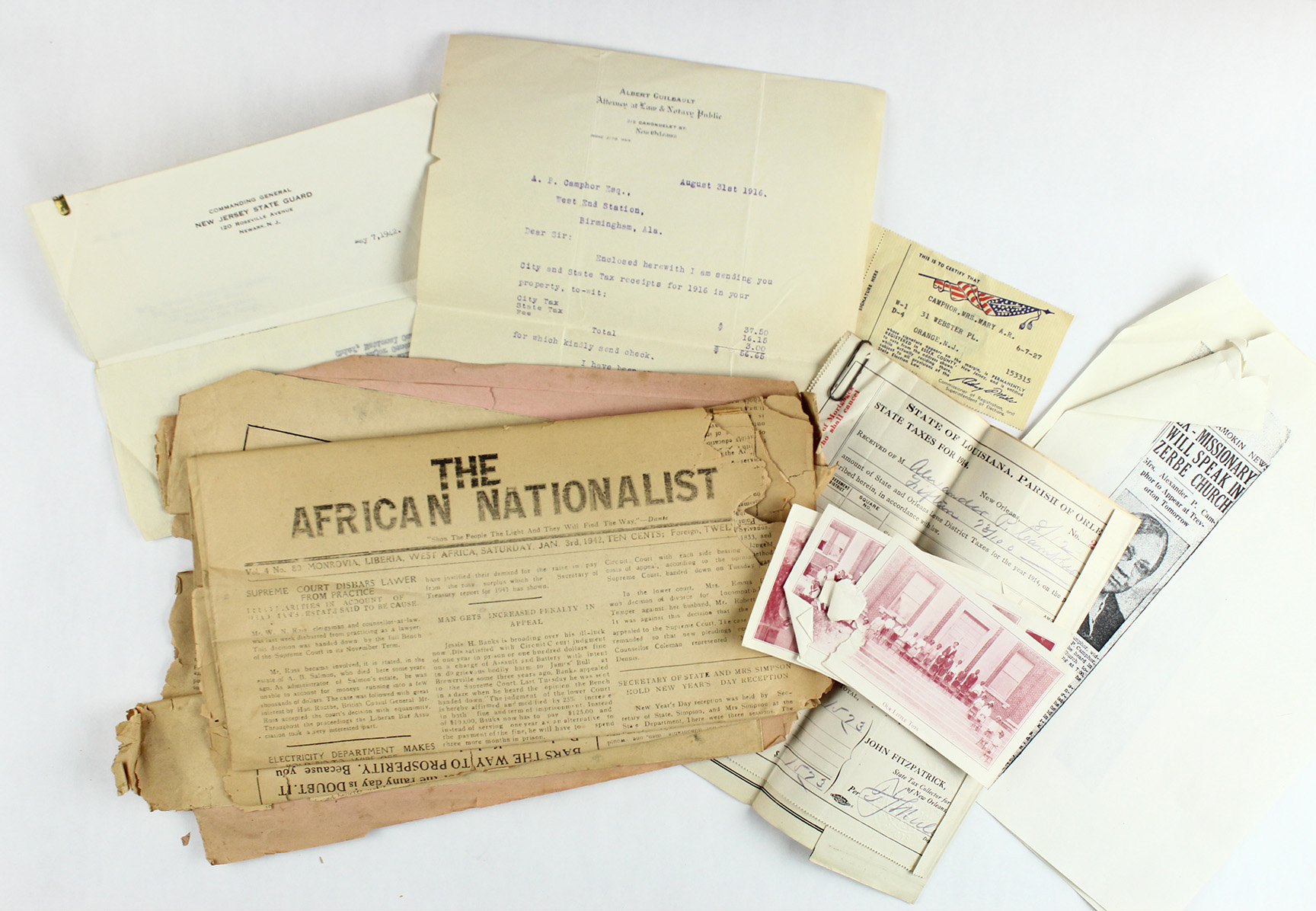
I also found this portrait of Camphor and his wife together with two of their fellow missionaries at an auction house sale of a set of photographs and other documents belonging to Camphor: I hope some school will buy these materials to archive and preserve for the future!


Here are some of the documents included in the auction lot (click for a larger view):


Camphor's book is not a systematic study with anthropological ambitions like Ellis's book about the Vai people of Liberia, but it is nevertheless a great folktale source. Enjoy!

by Alexander P. Camphor


Tuesday, November 9, 2021

Africa at the Internet Archive: Negro Culture in West Africa

For the past two days, I featured books by Elphinstone Dayrell, a British colonial official in Nigeria (the "Southern Nigeria Protectorate" as it was then called), but today I want to feature the work of a very different foreigner in Africa: George Washington Ellis (1875-1919), an African American lawyer who served in the American delegation to the Republic of Liberia. Here is a portrait of Ellis from The National Cyclopedia of the Colored Race (published in 1919):


During his posting in Liberia, Ellis undertook a decade-long study of the Vai people of Liberia, publishing Negro Culture in West Africa in 1914, a book that features both Vai folktales and proverbs, just a click away at the Internet Archive.


Here is a list of the stories, linking directly to the page where the story begins: The Rival Sleepers / The Man and the Goat / The Three Brothers and the Town / Man Hunting / The Race for a Wife / The Two Blind Men / Why the Elephant Runs from the Goat / Rival Brothers / The Fly, The Crab, and The Minnow / The Man and the Crabs / The Rival Doctors / The Man and his Chicken / Three Men Want First Smoke / Two Boys and the Snake / The Rabbit, The Snake, and the Ground Squirrel / The Deer and the Snail / The Tide and the Minnow / Three Rival Brothers / Rival Storytellers / Two Poor Men / Two Men Frightened / The Old Lady and the Little Boy / The Blind and Legless Men / The Spider and his Medicine / The Fox and the Goat / The Old Lady and the Bird / Three Royal Lovers / Two Bad Young Men / The Two Faithful Friends / The One Eyed Monarch / Poor Man and King's Daughter / The Blind Mori Man / The Little Boy and the Snake / The Two Thieves / The Father and Three Sons / The King and His Bangle / The Mori Man and the Secret / The Jealous Husband / The Man, The Deer, The Possum, and the Snake / The Lion, The Fox, and the Monkey / Two Great Swimmers / The Two Fighters / The Two Brothers / Two Unfortunate Men / The Lion, The Leopard, and the Dog / Three Storytellers / The Leopard and the Goat / Two Old Women / Two Orphan Brothers / Value of Education and Money / The Rascal Man / The Six Rival Heirs.

The chapter of proverbs is especially valuable because Ellis includes some commentary with each proverb, helping put it in its cultural context, like this explaination of The monkey wants to get honey but he has no ax to cut down the tree said in reference to a poor king with great ambitions but no money.


The book also contains chapters about other aspects of Vai life, along with photographs, like this photograph of musical instruments:


Here is a photograph of Vai singers:


Even when writing with admiration for African culture, white authors did not identify with African people in the deeply personal way that Ellis did. Although a foreigner in Liberia, he saw himself as a "Negro" who shared a cultural identity with all the people of "Negroland" that extended through the African diaspora around the world, forming a united culture connected back to Africa, as in the title of the book itself: Negro Culture in West Africa.

Ellis thus advocated for the special role that Black authors could play in documenting the cultures of Africa for audience beyond Africa: "the Negro should explain his own culture and interpret his own thought and soul life, if the complete truth is to be given to the other races of the earth."


Ellis was also convinced that the study of African culture was an essential element in fighting racism in the United States, and he corresponded with Du Bois and other African American leaders of the time, receiving encouragement from them for his African studies. 

While Ellis connected with the Vai people as an African American, he experienced a religious disconnect: he was a Christian but Islam was the dominant religion among the Vai. Ellis acknowledged the profound influence of Islam on Vai culture and traditions while fervently hoping that Christian missionaries would convert the Vai people to his faith. This did not happen; the Vai people remain predominantly Muslim today. 

So that is a prompt for me to write tomorrow about a book published by an African American missionary to Liberia, Alexander Camphor, a contemporary of Ellis.

Meanwhile, a wealth of stories and proverbs awaits you in Ellis's book:

by George Washington Ellis


Monday, November 8, 2021

Africa at the Internet Archive: Ikom Folk Stories from Southern Nigeria

Yesterday I wrote about Folk Stories from Southern Nigeria, West Africa by Elphinstone Dayrell, published in 1910, and today I want to follow up with a second book by Dayrell published in 1913: Ikom Folk Stories from Southern Nigeria, just a click away at Internet Archive:


The book contains 34 stories; here are links to the specific stories, so each story is just a click away also: How an Inkum Woman Abandoned One of Her Twins in the Forest / The Cunning Hare / The Story of Igiri and Her Husband Inkang / How Elili of Inkum Died, and Was Brought Back to Life Again / Concerning the Human Sacrifices / The Story of the Witch who Tried to Kill Her Husband / How Two Friends Fell Out: The Spider and the Grasshopper / How Ewa Abagi, an Inkum Woman, Was Drowned in the Cross River / The Story of the War between Inkum and Enfitop / How an Inkum Boy Was Drowned by His Companions / How a Father Tried to Kill One of His Sons but Failed / Concerning the Okuni Witches and Cannibalism / Of Chief Amaza, His Wife Achi, and the Tortoise / The Fate of Agbor the Hunter, Who Killed His Wife and Children / What Happened at Okuni When Anyone Was Killed by Accident / How Oghabi Poisoned His Friend Okpa / How Chief Alankor and All His Family Were Killed by a Big Frog / How the River Came into Existence / Why the Mist Rises from the Water / How Ibanang Okpong and Her Mother Were Swallowed by a Man-Eating Drum / Why the Head of the Male Goat Smells So Strong / A Story of the Great Famine / Why Edidor Killed Her Husband and Her Lover / How 'Nyambi Punished Chief Oga / How Two Bendega Young Men Changes Their Skins / Concerning the Ju-Ju against Elephantiasis / How a Cruel Inkum Chief Was Poisoned by His Slaves / How the Frog Beat the Bush Buck in a Race / Why a Python Never Swallows a Tortoise / The Game of Hide-and-Seek / Chief Kekong's Daughter 'Ndere who Married a Python / How Agbor Adam Broke the Hunting Law of Okuni / How Essama Stole Her Father's Goat in the Fatting-House / Quomodo Evenit ut Penis Primum Cum Vagina Coiit.

As you can see, that last story has its title in Latin, and the text is in Latin also.


This reflects a common practice in the 19th century in books published both in England and in the U.S. (I am not sure about other European countries?), and even well into the 20th century, where stories about sex were rendered not in English but in Latin in order to prevent access by women, children, house servants, etc. You can find this in literary translations, and also in anthropological projects like Dayrell's book. The unintended side effect, of course, is that it just makes the sexual stories that much easier to find! Since a reading knowledge of Latin is not as widespread now as it was a hundred years ago, I've translated the story below; it is really charming. (One of the retirement projects I've been contemplating is a big anthology of Latin stories like this taken from all the different kinds of books where these stories can be found.)

Unlike Dayrell's first book, in this book he does provide the names of the storytellers, which is quite intriguing in the case of the "Penis and Vagina" story, we know the storyteller is a woman. Dayrell also includes an introduction to this book where he provides some more information about his method for rendering the stories into English. Unlike Dayrell's first book, this book is not widely known at all, with very few citations in the literature, yet the stories in this book are just as valuable and fascinating, and I hope I can raise more interest in this book by including it here and listing the titles of the stories to pique people's interest. 

The book also has a few photographs as well, like this carved wooden drum:


There is also a portrait of Chief Indoma of Inkum who also figures as a character in two of the stories:


I've chosen a story from this book to include in my "public domain" project for today, so I'll update this post later with the audio for that story: The Great Famine.


In addition, I hopep you enjoy the story translated from Latin which you will find below. :-)

by Elphinstone Dayrell


The Latin is written in a very nice, simple style; I've included the Latin text transcribed below for anyone who is interested. 

How It Happened that the Penis First Had Intercourse with the Vagina

Once upon a time the Penis lived alone in the countryside, not too far from the Balls, his friends; the Balls were very skilled medicine-men who lived on the farm next door.
The Vagina lived in a little house just beyond Penis's estate. By chance Penis came to Vagina's house, and because he was hungry, he asked her if he could have some of the palm-nuts that she had just gathered in her garden since he had worked in the fields all day and hadn't been able to prepare anything to eat.
Vagina did not refuse his request but explained that she was poor and that Penis had to pay her back eventually.
Penis agreed and took the palm-nuts home for supper.
A little later Vagina was carrying a load of wood on her head and, finding herself not far from Penis's home, she remembered his debt to her. She entered his house and said, "O Penis, I'm hungry; I've been gathering wood all day and wasn't able to prepare anything to eat. Please pay back the palm-nuts you owe me."
Penis, however, refused, and Vagina demanded the nuts again, more insistently. When she finally realized that she wasn't going to get the nuts, she got angry and threw the firewood on the ground and then threw herself on the heap of firewood. One of the pieces of wood, an especially sharp piece, wounded Vagina in the leg, and she felt a terrible pain.
When Penis saw what had happened, he felt terrible. He pulled out the piece of wood, washed the wound with water, and took Vagina home.
But Vagina still did not stop crying as the wound was still very painful. This greatly troubled Penis, who was madly in love with Vagina, even though he had refused to pay back the palm-nuts he owed her. 
So, Penis went back home and ordered one of his servants to hurry to Vagina's house and apply medicine to her wound. The servant did this, but Vagina continued to groan just as loudly as before, demanding that the Penis heal her in her sickness as this was all his fault. The servant went back to Penis and reported what Vagina had said.
Penis thought carefully about what the servant told him and decided to go at once to his friends, the Balls, since they were reputed to be very wise. When the Balls learned about Vagina's wound, they said that Penis could cure Vagina if he did exactly what they told him. Delighted, Penis promised that he would do whatever was required.
In those days, Penis was never stiff, but the Balls said, "We will fill you with a liquid that will make you stiff. Then, go to Vagina and insert yourself into the wound. Then bring yourself almost all the way out, and then plunge into the wound again and again, until you have squirted all the liquid that we filled you with into the wound."
"But what if some enemy of mine attacks me when I've got my sword in the wound like that?" asked Penis. "He could catch me unawares and kill me!"
"Don't worry," said the Balls. "We'll keep watch from the rear so that nothing bad will happen to you."
So Penis hurried to Vagina and did everything the Balls had told him to do. Vagina said that the medicine was very helpful, and she begged Penis to to come to her every night and heal her wound in exactly that way. After a few days, Vagina felt better, but she still had a deep crack in her flesh. 
Since that time, the Balls and Penis have worked together so that the Balls fill Penis with liquid whenever he sees Vagina and he becomes strong. But if Vagina doesn't feel well or if she's in a really bad mood, then Penis doesn't become stiff and can't enter the crack.

(Told by Ennenni, a singing and dancing girl of Okuni; May 18th, 1911.)


Here is Latin. One odd thing about the Latin is that while Testiculi are plural here in the Latin, they are referred to with singular verbs and nouns (hand procul a Testiculis, amico eius); that's awkward in the Latin and it was also very awkward in English, which is why I used plural verbs and nouns in the English translation above.

Quomodo Evenit ut Penis Primum cum Vagina Coiit

Penis autem olim rure solus habitabat, hand procul a Testiculis, amico eius, qui magus erat valde peritus, atque fundum proximum incolebat.
Ultra tamen praedia Penis villam parvam habebat Vagina. Penis forte ad villam Vaginae vagatus, et fame afflictus, illam palmae nuces, quas nuper in horto collegerat, rogavit, scilicet quod ipse totam diem in agro laborasset nec sibi cibum parare potuisset. Nec abnuit Vagina, sed se pauperem esse dicebat, et Penem debitum reddere alio tempore opportere. Quo pacto Penis cum nucibus abiit.
Paulo postea Vagina hand procul ab aedibus Penis ligna capite ferebat, et, debiti memor, domum eius aggressa, "Esurio " inquit " O Penis, cum totam diem haec ligna collegi, nec mihi cibum parare potui. Redde igitur nuces quas debes." 
Penis tamen noluit, et Vagina iterum vehementius nuces postulabat; deinde, cum se nihil profiteri sentiret, ligna in terram irata deiecit, seque insuper prostravit. Unum autem e lignis quod peracutum erat Vaginam inter crura altius vulneravit, gravique dolore afflixit. Quod visum Penis aegre ferebat, atque ligno extracto et vulnere aqua perluto Vaginam domum duxit. 
Haec tamen interdum, magno dolore pressa, lamentari non desinebat, quod maxime Penem pigebat, qui eam penitus amabat, etiamsi nuces debitas reddere noluerat. Itaque Penis domum regressus servum iussit in villam Vaginae properare atque vulneri medicamenta adhibere. 
Quo facto servus, cum Vagina nihilominus inter gemitus vociferabat se vehementer dolentem sanari a Pene opportere qui causa malorum fuisset, ad Penem regressus ea quae dixerat Vagina nuntiavit.
Quae audita Penis diu meditatus statim ire amicum suum, Testiculos, consultum statuit, qui maxime sapiens diceretur. At Testiculi, de Vaginae vulnere certior factus, dixit Penem Vaginam sanare posse si verbis suis obtemperet, et Penis laetus se velle omnia facere quae necesse essent asseverabat.
Eo autem tempore Penis nunquam erectus fiebat. Itaque Testiculi "Liquore" inquit "te implebo ita ut erectus fias; deinde i ad Vaginam teque in vulnus insere; quo facto te paene foras extractum iterum atque iterum in vulnus impelle, dum tandem liquorem quo te implevi in vulnus vomes." 
"At si quidam" inquit Penis "inimicus mihi gladio instabit iam in vulnere condito, inopinantem interficere poterit." 
"Bono animo es" inquit Testiculi; "ego enim a tergo vigilabo pro te ne quid infaustum accidat." 
Itaque Penis ad Vaginam properavit et omnia quae amicus iusserat perfecit. At Vagina medicinam sibi magnopere profuisse dixit, et Penem precata est ut omni quaque nocte veniret eodem modo vulnus sanaturus. Paucis itaque diebus Vagina convaluit, sed rima alta in corpore manebat. Ex eo tempore etiam Testiculi et Penis in uno iuncti sunt, ita ut Testiculi, quoties Penis Vaginam videat, eum liquore implet per quem validus fit. At si quid incommodi Vagina habeat, vel alio sit qui vehementius rixetur, tum Penis erectus non fit, nec rimam intrare potest.

Sunday, November 7, 2021

Africa at the Internet Archive: Folk Stories from Southern Nigeria

Week 26 begins, and for the month of November, I'm focusing on public domain books in tandem with my NaNoWriMo project: PublicDomain.LauraGibbs.net. 

So, that brings me to today's book, which is a collection of folktales from southern Nigeria: Folk Stories from Southern Nigeria, West Africa by Elphinstone Dayrell, just a click away at the Internet Archive. 


Dayrell was a colonial administrator in Nigeria in the early 20th century, and he published this book in 1910; he also published a collection of Ikom stories from Nigeria which I will write about tomorrow. This is an incredibly valuable collection of traditional stories and a real pleasure to read. The book contains 40 folktales; these links go directly to the page with that story: The Tortoise with a Pretty Daughter / How a Hunter obtained Money from his Friends the Leopard, Goat, Bush Cat, Cock, and how he got out of repaying them / The Woman with Two Skins / The King's Magic Drum / Ituen and the King's Wife / Of the Pretty Stranger who Killed the King / Why the Bat flies by Night / The Disobedient Daughter who Married a Skull / The King who Married the Cock's Daughter / The Woman, the Ape, and the Child / The Fish and the Leopard's Wife; or, Why the Fish lives in the Water / Why the Bat is Ashamed to be seen in the Daytime / Why the Worms Live Underneath the Ground / The Elephant and the Tortoise; or, Why the Worms are Blind and why the Elephant has Small Eyes / Why a Hawk kills Chickens / Why the Sun and the Moon live in the Sky / Why the Flies Bother the Cows / Why the Cat kills Rats / The Story of the Lightning and the Thunder / Why the Bush Cow and the Elephant are bad Friends / The Cock who caused a Fight between two Towns / The Affair of the Hippopotamus and the Tortoise; or, Why the Hippopotamus lives in the Water / Why Dead People are Buried / Of the Fat Woman who Melted Away / Concerning the Leopard, the Squirrel, and the Tortoise / Why the Moon Waxes and Wanes / The Story of the Leopard, the Tortoise, and the Bush Rat / The King and the Ju Ju Tree / How the Tortoise overcame the Elephant and the Hippopotamus / Of the Pretty Girl and the Seven Jealous Women / How the Cannibals drove the People from Insofan Mountain to the Cross River (Ikom) / The Lucky Fisherman / The Orphan Boy and the Magic Stone / The Slave Girl who tried to Kill her Mistress / The King and the 'Nsiat Bird / Concerning the Fate of Essido and his Evil Companions / Concerning the Hawk and the Owl / The Story of the Drummer and the Alligators / The 'Nsasak Bird and the Odudu Bird / The Election of the King Bird.

For my Public Domain project, I chose one of my favorite trickster tortoise stories from this book: The King's Magic Drum. Here's an audio recording I made too!


One of the great things about these old books of folktales have been used as sources of ideas and inspiration by modern writers, especially the authors of children's books. Here are two books which are inspired by stories found in Dayrell's book:

by Blair Lent


Here are Sun and Moon greeting Water:


And here is Water with all his family:


by Ashley Bryan


Here are Sheep Thunder and Ram Lightning:


And here is Ram Lightning causing trouble:


The book illustrated by Blair Lent was a Caldecott Honor book back in 1969; you can find out more about Lent's life and work at Wikipedia. You might recognize Ashley Bryan (and his distinctive style!) from many previous blog posts, most recently: The Dancing Granny. This link takes you to a page with all the Ashley Bryan books featured in this blog so far.

So, enjoy! You can take a look at these beautifully illustrated children's books if you want, or just plunge right in to all the stories in Dayrell's book:

by Elphinstone Dayrell