Showing posts with label IAAW6. Show all posts

Friday, June 25, 2021

African Folktales at Internet Archive: Abrahams' African Folktales

I'll finish up this week of anthology recommendations with another outstanding scholar, Roger Abrahams, a contemporary of Harold Sheub (from yesterday's post); you can read about Abrahams' life and career at Wikipedia. Abrahams did most of his own work in the United States and the Caribbean, looking at African traditions in the Americas, and he is also the author of a wonderful anthology:  African Folktales: Traditional Stories of the Black World. It's just a click away at the Internet Archive.


There are 93 stories in the book from all over Africa, organized thematically: the first part contains "tales of wonder from the great ocean of story," the second part contains "stories to discuss and even argue about" (dilemma tales!), the third part (my favorite) contains "tales of Trickster and other ridiculous creatures: tales to entertain," the fourth part contains two epic tales, and the final part contains a hodgepodge of stories which Abrahams calls "making a way through life." It's an excellent collection with notes on each story and detailed bibliography.

You can also see other books by Roger Abrahams at the Internet Archive; I'll be sharing these books here when I move on from African folklore recommendations to books from the Americas... but that will be a while: there are so many excellent African folklore books yet to recommend!


So, here's all of Week 6 on one page, concluding with this great collection by Roger Abrahams:

by Roger Abrahams


Thursday, June 24, 2021

African Folktales at Internet Archive: Scheub's African Storyteller

Yesterday I wrote about an anthology of African stories by Paul Radin who was one of the leading anthropologists in the first half of the 20th century, and today I want to write about one of the leading anthropologists in the second half of the 20th century: Harold Scheub, who was born in 1931 and who died very recently, in 2019. You can read about his life and career at Wikipedia. There are several of his books available at Internet Archive based on his work in southern Africa which I will feature in later posts, but the book for today is the anthology that he edited of stories from all across Africa: The African Storyteller: Stories from African Oral Traditions. The book is just a click away at the Internet Archive. 


The book has actually appeared in two different editions; the edition at the Internet Archive is from 1990, and the edition I have is from 1999, but the books are fundamentally the same (there are a few stories that are different, but the overall organization is the same; you can compare them here). The stories are organized thematically, with introductory materials to each section about the theme, along with notes and commentary on each story. If you are thinking of buying a used copy of the book (which are widely available because the book was commonly used as a college textbook), either edition is good!

In addition to the 50 stories in the book, there are wonderful little insets throughout the book where Scheub quotes passages from other scholars and researchers who study African storytelling traditions, like this passage from A. C. Jordan, whose book Tales from Southern Africa I had featured here a few weeks ago:


The stories come mostly from published sources in English, but there are a dozen stories that come from non-English sources, including some translations from oral performances, including two extraordinary stories that Scheub recorded: the Zulu story of the trickster Chakijana, and the Xhosa story of the hero Sikhuluma (the roles of the hero and the trickster were Scheub's special areas of interest). 

Scheub also includes photographs from those storytelling sessions, like this photograph of Nongenile Masithathu Zenani, a Xhosa storyteller, whose work appears in this book edited by Scheub: The World and the Word: Tales and Observations from the Xhosa Oral Tradition, available at Internet Archive also.


I'll have more to say about Scheub's work with Xhosa storytellers in future posts, and with this anthology he does a brilliant job of sketching a framework for the larger dimensions of the storytelling traditions across the African continent: HIGHLY recommended.

by Harold Scheub


Wednesday, June 23, 2021

African Folktales at Internet Archive: Radin's African Folktales

The theme for this week is anthologies (see all this week's posts on one page), and today I want to write about a classic anthology of African folklore: African Folktales by Paul Radin, first published in 1952 as a book of sculpture and stories, and then reissued in 1964 with just the stories. The Internet Archive has both editions available: the African Folktales and Sculpture edition and also the text-only African Folktales book:


Here's a screenshot of the thumbnails display of the sculpture book; the sculptures are amazing, even just in the form of black-and-white photographs:

Plus the digital scan lets you zoom in, like this Baga idol from West Africa for example (more about the Baga people):

There are 81 stories in the book drawn from a variety of sources, including German-language sources that Radin translated into English. 

Paul Radin was a leading folklorist in the first half of the 20th century, specializing in Native American storytelling traditions, especially among the Winnebago (Ho-Chunk) with whom he lived and worked in the years 1908-1912. It was through his work on Native American traditions, especially the figure of the trickster, that he became interested in African traditions. He was a prolific author, and you can find many books by or about Radin at the Internet Archive.

And hey, since the sculpture pages are not interspersed with the stories, here's an idea: you could check out BOTH books at once, looking at the sculptures in one browser window while enjoying the stories in another browser window: a simultaneous viewing option that the folktales and sculpture book itself does not allow. Beautiful images, beautiful stories, both at once:

African Folktales
edited by Paul Radin


African Folktales and Sculpture
edited by Paul Radin


Tuesday, June 22, 2021

African Folktales at Internet Archive: Courlander's Treasury of African Folklore

Continuing on with the anthology theme for Week 6, I want to feature one of my very favorite folklore writers: the great Harold Courlander. I'll be sharing more of his books in future posts; meanwhile, the Courlander book for today is his massive compendium, A Treasury of African Folklore, first published in 1975, and all 650 pages of this wonderful book await you at the Internet Archive, just a click away. It is very much worthy of its subtitle: oral literature, traditions, myths, legends, epics, tales, recollections, wisdom, sayings, and humor of Africa.


Here is how Courlander summarizes the contents in the introduction:

The range of African oral literary forms is seemingly endless. it includes creation myths, myth-legends, half-legendary chronicles and historical narratives either in song or prose; tales that explain natural phenomena, tribal practices and taboos, and cultural or political institutions; stories and fables that reflect on the nature of man and his strengths and weaknesses; tales of adventure, courage, disaster, and love; epics with legendary heroes or fictitious heroes, and tales of confrontation with the supernatural and unseen forces of nature; moralizing stories and stories that define man's place and role in the universe; riddles that amuse and teach, and proverbs that stress social values; and a virtually inexhaustible reservoir of animal tales, many of which, at bottom, are morality plays, while other are purely humor.

And of course you know I'm here for that last part: the inexhaustible reservoir of animal tales. 

Courlander was a world traveler and a prolific writer; you can read about his career at Wikipedia. In addition to his many folklore books and also novels, Courlander was a serious musicologist, and you can listen to some of his recordings at the Internet Archive. He was especially interested in the musical traditions of Haiti and Afro-Cuban music, and here is one of his Haitian drum recordings: Baboule Dance:


So, this is just the first time I've written about Courlander here at this blog, but it will not be the last: I will have more Courlander books to share as I work through the African folklore books in the coming months, and then yet more Courlander books to share again when I move on to the books about African folklore in the Americas and the Caribbean.

But for now, there is plenty to keep you busy here with this fabulous treasury: it is full of treasures indeed!

by Harold Courlander


Monday, June 21, 2021

African Folktales at Internet Archive: The River that Went to the Sky

This week I'm focusing on African story anthologies at Internet Archive; yesterday, I wrote about Mandela's Favorite African Folktales, and the book for today is another anthology: The River that Went to the Sky: Twelve Tales by African Storytellers, edited by Mary Medlicott, just a click away at Internet Archive.


The book has also been reissued under a different title: Tales from Africa.


Here are the different regions of Africa that are represented in the 12 stories:


Mary Medlicott is a storyteller based in the U.K., and you can find out more about her books here at her website: Storyworks.org. There are notes from each of the storytellers in the back of the book, and one of the storytellers — Gcina Mhlophe— appeared in an earlier blog post in this series with her book, Stories of Africa. 

Some of the stories in this book are traditional folktales, while others are contemporary stories. As Medlicott explains, "The wells of African oral tradition are deep. Now, more than ever before, the world needs the refreshment they offer. But Africa today is a place of huge modern cities as well as traditional villages. I felt it vital to reflect that." 

So, for example, there is a story by Sousa Jamba, "My Godfather," which is based on his own life experiences; born in 1966, he fled Angola in 1975 to escape the civil war, growing up as a refugee in Zambia. You can find out more about Jamba's life and work at Wikipedia.

The illustrations are by a Nigerian artist, Ademola Akintola, who you can follow at Instagram. His artwork really adds to the stories; here's an illustration for a story about Ananse's son on a trip to the market... and yes, drumming is an important part of the story:


So, for a wonderful survey of Africa, both traditional and modern, this book is a great choice:

edited by Mary Medlicott


Sunday, June 20, 2021

African Folktales at Internet Archive: Mandela's Favorite African Folktales

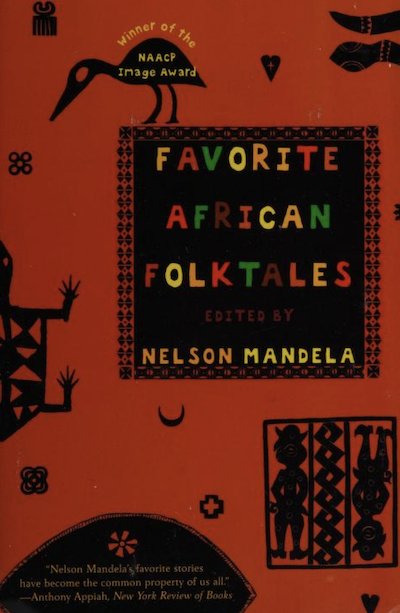
Last week I focused on books of stories from northern Africa, and the week before that I focused on southern Africa, but this week instead of focusing on a specific region, I want to do something different: the theme this week is anthologies of African stories that bring together stories from across the continent. I'll start with what is probably the best known anthology of African folktales: Favorite African Folktales, edited by Nelson Mandela, which is just a click away at the Internet Archive.


The book first appeared in 2002, and it was published in South Africa under the title "Madiba Magic: Nelson Mandela's Favorite Stories for Children" (Madiba being Mandela's Thembu clan name, which was used as a nickname). You'll find 32 stories here, primarily from South Africa but from other regions also (Kenya, Nigeria, Morocco, and more), with a helpful map at the front of the book. Some of the legends appear here in English for the first time (translated from books written in Afrikaans). There is a detailed bibliography in the back of the book, plus a note at the start of each story to put it into context.

Mandela wrote the foreword, with some lovely thoughts about folktales and their travels: 

A story is a story; and you may tell it as your imagination and your being and your environment dictate; and if your story grows wings and becomes the property of others, you may not hold it back. One day it will return to you, enriched by new details and with a new voice. ... It is my wish that the voice of the storyteller will never die in Africa, that all the children in the world may experience the wonder of books, and that they will never lose the capacity to enlarge their earthly dwelling place with the magic of stories.

And speaking of new voices, there's also a celebrity cast audiobook with readings of the stories by LeVar Burton, Don Cheadle, Whoopi Goldberg, Forest Whitaker,  Alfre Woodard, and more. See Audible.com for more information about the audiobook.

Unfortunately, the audiobook is not available at Internet Archive, but the book is, and it's a fantastic place to start learning about the different storytelling traditions of Africa.

Favorite African Folktales
edited by Nelson Mandela