Showing posts with label IAAW84. Show all posts

Tuesday, March 14, 2023

Tricksters. Wisahketchahk spreadsheet

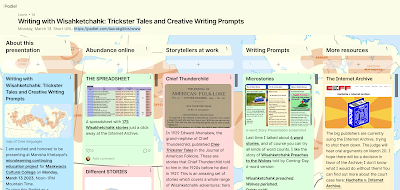
To finish up this week of Wisahketchahk stories, I don't have a book... I have a spreadsheet, which is FULL of books and articles from the Internet Archive, featuring 175 different Wisahketchahk stories. Here is a link to the spreadsheet:


This was part of a presentation for Maskwacis Cultural College; you can see the presentation here in the form of a Padlet: Writing with Wisahketchahk: Trickster Tales and Creative Writing Prompts.

Using the search tools at the Internet Archive to find all these stories was an amazing experience! This character's name is spelled in different ways in English, so searched diligently for all the different spellings, and I found so many stories, most of them from Cree storytellers, which made it even more exciting. 

As readers of this blog may know, oral arguments in the publishers' lawsuit against the Internet Archive will be heard on Monday, March 20. The proceedings are not being livestreamed, but you there will be a live-Zoom-commentary with Michelle Wu and Kyle Courtney: register for the link.



Monday, March 13, 2023

Tricksters. 3 Wesakaychak stories

One of the treasures that I found while looking for Wesakaychak stories at the Internet Archive was this series of 3 books in Cree and English, each with a different story about Wesakaychak, and illustrated by the students at St. Andrew's School on the James Bay coast in Kashechewan, Ontario.

Saturday, March 11, 2023

Tricksters. Cree Trickster Tales.

I have a wonderful addition to this week of Wesakachak stories: these are the stories told by Chief Thunderchild in the 1920s to Edward Ahenakew, which Ahenakew published in the Journal of American Folklore in 1929: Cree Trickster Tales. 


This is a remarkable collection of stories, and it covers a wide range of the Wesakachak cycle, beginning with his birth and the drama of his mother, the rolling head, and ends with his departure from this world into some place unknown. 

You can read more about the life of Chief Thunderchild, Peyasiw-Awasis, at The Canadian Encyclopedia Online. This photo was taken around 1925; Thunderchild was born in 1849 and died in 1927.


There is an article about Ahenakew at Wikipedia, whose grandfather was the brother of Chief Ahtahkakoop, making Ahenakew Chief Ahtahkakoop's great-nephew.

After Edward Ahenakew's death in 1961, papers were found with the other stories he heard from Chief Thunderchild, and these were finally published in 1973. That book is also at the Internet Archive! They are beautiful resources for learning about Chief Thunderchild and the world that he knew: Voices of the Plains Cree.


Friday, March 10, 2023

Norman. Trickster and the Fainting Birds

Carrying on with this week of Wesakachak stories, I have a lovely book by Howard Norman (he also wrote a Glooskap book that I posted about previously). You'll find seven Wesakachak stories here: Trickster and the Fainting Birds.


The stories are: Trickster and the Best Hermit, Trickster and the Shut-Eye Dancers, Trickster Tells Whiskey Jack the Truth, Trickster and the Walking Contest, Trickster and the Clacking Sleeves, Trickster and the Night-Tailed Weasels, and Trickster and the Fainting Birds.

Norman gathered these stories from Cree storytellers starting back in the 1970s, stories about Wistchahik, Wesucechak, Wichikapache, etc. the specific name being based on the Cree community where the storyteller was from. In this book, he has just used "Trickster" as the name for the hero of the stories. Be sure to read the introduction where Norman explains how he worked with Cree storyteller Albert Sandy, learning about the ways of Wistchahik, and there are also story notes in the back.

The lovely illustrations are by Tom Pohrt. Here is Trickster in his fish-head-and-bones coat in the story of Trickster and the Clacking Sleeves:


You can find out more about Howard Norman and his work at Wikipedia, and there are more of his books at the Internet Archive, all just a click away! 

by Howard Norman


Thursday, March 9, 2023

Tricksters. Indigenous Stories from Turtle Island

As Frank Speck's use of Latin (!) in yesterday's collection of Cree stories, he was writing very much as an outsider, and censoring what he found. I wanted to share something very different for today's addition to the week of Wisahkecahk stories; this time it's a wonderful collection of stories by Indigenous writers: Read, Listen, Tell: Indigenous Stories from Turtle Island, edited by Sophie McCall, ‎Deanna Reder, and  ‎David Gaertner. 


Three items in this book work with Wisahkecahk traditions: An Athabasca Story by Warren Cariou is a short story about "Elder Brother," which is one of the mames by which Wisahkecahk is known.

There is also an excerpt from Darkness Calls by Steven Keewatin, a graphic novel!


Finally, there is an excerpt from The Kiss of the Fur Queen by Tomson Highway. 

Plus, if you like Tomson Highway's work, you can read that entire novel at the Internet Archive too: Kiss of the Fur Queen; you can also find more by Tomson Highway at the Archive, and you can find out more about Tomson Highway at Wikipedia. 


So now that we've had one very old account of Wisahkecahk and this more modern book, I'll be back with more Wisahkecahk stories tomorrow.

by Sophie McCall, ‎Deanna Reder, and  ‎David Gaertner


Wednesday, March 8, 2023

Tricksters. Myths and Folklore of the Timiskaming Algonquin

This week of trickster resources at the Internet Archive is going to be dedicated to Wisakedjak, the trickster hero of the Cree and other Algonquin peoples. I'll start with an old book by Frank Speck: Myths and Folklore of the Timiskaming Algonquin and Timagami Ojibwa.


This book was published in 1915, and it features a cycle of Wisakedjak stories told by Benjamin Mackenzie of Timiskaming Band in 1913. Speck published only the English translations, but he retains the distinctive features of the storyteller's style, such as the way he ends the stories as if he were a spectator at the events of the story: "So I had some travelling to do and I left Wisakedjak there, and I don't know where he went."


Did you notice that part of that fourth title is in Latin? Yep. That's because even though Speck is transmitting the story as told by Benjamin Mackenzie, he is also censoring the story, turning all the references to Wiskedjak's butt (specifically, his butt-hole, Latin anus) into Latin to protect innocent readers, mixing the Latin right in with the English, just as he did there in the title: Wiskedjak Anum Suum Urit and Originates Rock-Weed and Red Willow from the Scabs (Anum Suum Urit means "burns his butt"). Many anthropologists of the time did the same, and I've often thought about creating an anthology of these Latin stories and bits of stories! So in this story, every time there is a reference to the trickster's butt, Speck puts that in Latin. Wiskedjak tells his butt o stand guard over the roasting ducks, but when the butt warns Wiskedjak, Wiskedjak doesn't listen, and then when the ducks are stolen, he gets angry at his butt and decides to burn it... but of course that means he is burning himself! And it hurts!

These stories about Wiskedjak are sometimes told about other tricksters too; you might recall the story of the skull from a book I wrote about earlier: Iktomi and the Buffalo Skull: A Plains Indian Story. The details of the two stories are very different: Wiskedjak follows ants into a bear-skull where they are eating the brains, while Iktomi follows the mice into a buffalo-skull where the mouse are having a pow-wow. To me, that's just fascinating: it tells us that the story traveled far, from one storyteller to another to another, with each storyteller adjusting and changing the story along the way!

I'll be back with more Wiskedjak stories tomorrow!