Showing posts with label IAAW61. Show all posts

Saturday, August 6, 2022

African Diaspora at Internet Archive: Negro Folklore in America

I'm wrapping up this week of scholarly work by a remarkable document: Types and Distribution of Negro Folklore in America by Vivian Costroma Osborne-Marsh. 


This is a master's thesis for the Department of Anthropology at the University of California at Berkeley in 1922, and Osborne-Marsh was among the first African Americans to receive a master’s degree from UC-Berkeley.

Her thesis is the first systematic attempt to trace the origins of African American folktales back to their African origins. She worked with published sources, while also collecting stories from living storytellers (you can see the list of 27 informants in one of the appendices). She also takes up the question of the stories shared among African American stories in the southeastern United States and Native American storytellers. Her bibliography is a good survey of what it meant to attempt to study this topic 100 years ago.

You can find out more about Osborne-Marsh's life and career at Wikipedia, and there is also a retrospective at this Berkeley webpage celebrating 150 Years of Women at Berkeley: Vivian Costroma Osborne Marsh (1897-1986) which is the source of this photograph:


There's one page missing here from the scan, so if anybody from Berkeley happens to read this and can access the hard copy at Berkeley and take a picture of p. 24 with their phone, that would be wonderful! I haven't been able to find any other scan of the thesis other than the one with the missing page. :-)

Friday, August 5, 2022

African Diaspora at Internet Archive: Roger Abrahams

Since Helen read a story from Roger Abrahams' African Folktales book, I thought I would use that as a prompt to do two more books from Roger Abrahams today, carrying on with this week's theme of excellent scholarly resources.


The book is a collection of essays by Abrahams covering a range of topics connected to poetic performance throughout the area of the Caribbean known as the West Indies (see Wikipedia), with essays dating back to the 1960s when Abrahams was doing field research in the Antilles.

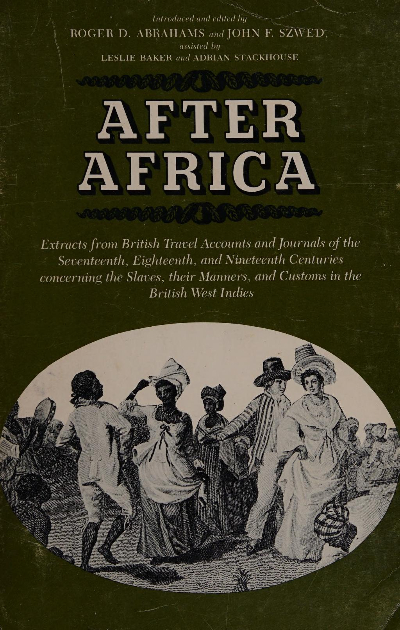
Abrahams dedicated this book to John Szwed, who is his coauthor on this book, also published in 1983: After Africa: Extracts From British Travel Accounts and Journals of the Seventeenth, Eighteenth, and Nineteenth Centuries Concerning the Slaves, Their Manners, and Customs in the British West Indies. (Abrahams died in 2017, but John Szwed, who was born in 1936, is still with us!)


Each of the chapters of this book contains fascinating material... and there is even a chapter on Anancy Tales, which opens with testimony that dates back to 1816 from Matthew Gregory Lewis; you can find out more about Lewis here.

Plus of course I want to include both of Abrahams' monumental anthologies of African and African American folktales!


All of these excellent books are just a click away at the Archive, all because of Conrolled Digital Lending, which creates a scholarly library that we can all access.


by Roger Abrahams


by Roger Abrahams and John Szwed


Wednesday, August 3, 2022

African Diaspora at Internet Archive: African Folklore in the New World

I've got another two examples of outsanding secondary literature for the study of African Diaspora folktales, both just a click away at the Internet Archive:

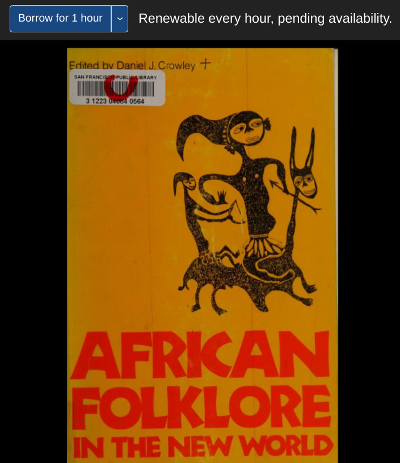
First up is African Folklore in the New World edited by Daniel Crowley, and published in 1977:


This is a collection of six important essays, and readers of this blog will find some familiar names here among the authors, including William Bascom, Roger Abrahams, Alan Dundes, and Richard Dorson. 

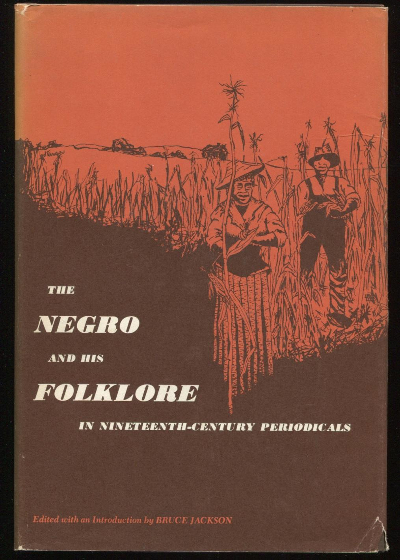
The other book is an incredibly useful anthology of primary sources: The Negro and His Folklore in Nineteenth-Century Periodicals edited by Bruce Jackson. As you can guess from the title, this is an older book, published in 1967.


You will find 32 articles reprinted here from periodicals like The Atlantic Monthly and Harper's which still exist today, along with important 19th-century periodicals that are no more, like Lippincott's Magazine. You will see a few familiar names among the authors, like Joel Chandler Harris and Alice Bacon, even Antonín Dvořák, but most of the authors are long forgotten, and Jackson has done a great service by collecting these materials, some of them very hard to find even in the digital world of today.

These are both books i am proud to have on my own bookshelves, and it is so exciting that the Internet Archive is making them available online, thanks to the power of Controlled Digital Lending!


edited by Daniel Crowley


edited by Bruce Jackson


Tuesday, August 2, 2022

African Diaspora at Internet Archive: Slave Culture

The theme this week is secondary literature, and the author I want to feature is the great historian Sterling Stuckey, starting with this monumental book, published in 1987: Slave Culture: Nationalist Theory and the Foundations of Black America.


You can get a sense of the book's argument from its opening paragraph:
The final gift of African "tribalism" in the nineteenth century was its life as a lingering memory in the minds of American slaves. That memory enabled them to go back to the sense of community in the traditional African setting and to include all Africans in their common experience of oppression in North America. It is greatly ironic, therefore, that African ethnicity, an obstacle to African nationalism in the twentieth century, was in this way the principal avenue to black unity in antebellum America. Whether free black or slave, whether in the North or in the South, the ultimate impact of that development was profound.
Stuckey explores these same themes in this later collection of essays: Going Through the Storm: The Influence of African American Art in History, published in 1994. 


Notably, this book opens with a foundational essay that Stuckey first published in 1968: "Through the Prism of Folklore: The Black Ethos in Slavery." Here is how Julius Lester characterized the essay in a New York Times review: 
Stuckey places the spiritual in its slavery con text, showing how it was a major weapon of resistance to that dehu manizing institution (which others have found only “peculiar”) and the principal means through which the slaves fashioned and maintained an identity separate from that which the slaveholders fought to impose upon them.
Another essay of great importance for looking at African diaspora stories in African American storytelling: "Black Americans and African Consciousness: Du Bois, Woodson, and the Spell of Africa."

You can find out more about Stuckey's life and career in this Wikipedia article about him, and his obituary appeared in the New York Times; he died just a few years ago, in 2018.

I was so glad to find both of these books available at the Internet Archive!


by Sterling Stuckey


Monday, August 1, 2022

African Diaspora at Internet Archive: Black Culture and Black Consciousness

For this week, I'm going to be focusing on valuable reference materials and scholarly studies at the Internet Archive that can help us in studying African Diaspora folktales, and I wanted to start with this foundational work: Black Culture and Black Consciousness: Afro-American Folk Thought From Slavery to Freedom by Lawrence Levine.


This is the 30th-anniversary edition of the book published in 2007; the original was published in 1977. It's wonderful to have access to this edition because it includes a long new preface written by the author to put the book in context, explaining how he came to write the book and how it was deeply connected to the Civil Rights struggles of the 1960s, and also how he immersed himself in the study of anthropology and, specifically, folklore (!!!) in order to write the book.

Levine completed the preface in September of 2006, and he died in October of that same year, at the too young age of 73. You can read about his life and career at Wikipedia. You can also read the tribute to him in the New York Times:  Lawrence W. Levine, 73, Historian and Multiculturalist, Dies; here's an excerpt:
Mr. Levine’s most critically acclaimed work was probably “Black Culture and Black Consciousness: Afro-American Folk Thought from Slavery to Freedom” (1977). In it, he examined religion, music, humor, folk tales and superstitions to show how slaves developed their own culture within the confines of slavery. He said that jokes told by slaves represented an effort to laugh even during their trials.
You can also find the original edition of the book, plus more books by Levine at the Archive too:


This book had a huge impact on me when I read it back when I first started working on the Joel Chandler Harris corpus of stories, and this 30th-anniversary edition was the one that I read also, so I was so glad to see that it is available at the Archive. Highly recommended!

by Lawrence Levine