Showing posts with label IAAW83. Show all posts

Tuesday, March 7, 2023

Trickster. The Tortoise in Zambia

In yesterday's post I shared some trickster Tortoise stories from eastern and southern Africa, and I'll finish up this week of Tortoise stories with stories from The Ila-Speaking Peoples of Northern Rhodesia [Zambia] by Edwin Smith and Andrew Murray Dale, published in 1920. The book was published in two volumes, and the folktales are in Volume II.


You can read more about the Ila people of Zambia and about the Ila language (a Bantu language) at Wikipedia. Fulwe is the Tortoise's Ila name, and his trickster rival is Sulwe, the hare. Some of the Tortoise stories in this book are part of the Hare cycle of stories: Tortoise and the Fish-Eagle, Why the Cracks in Tortoise's Shell, Hare's Destiny Foretold by Tortoise, Hare is Outwitted by Mrs. Tortoise, and Hare's Last Adventures and Death.

And for a more contemporary book from Zambia, here is The Magic Tortoise: Further Tales From the Forest for Children in Africa by Adrian Storrs, published in Lusaka in 1974. 


These are not traditional Tortoise folktales; instead, this is a book of stories about a wise old Tortoise who helps both humans and animals to thrive and prosper. The illustrations are by Joan Blakeney, and here, for example, the Tortoise helps the farmer to better irrigate his vegetables so that he can grow more and better food for the people to eat:


There is a first volume of stories entitles The Tortoise Dreams, but it is not available at the Archive. Hathi Trust has a copy of that book but, because it is copyrighted, you cannot read it there. Maybe someday Controlled Digital Lending will come to Hathi Trust, and then we'll be able to read another book of stories. Based on the contents of this follow-up book, I suspect The Tortoise Dreams is also a book of stories about developmental efforts in Zambia, with the Tortoise as a kind of wise guide.

So, this use of the Tortoise helps highlight the range of ways in which a trickster character like the Tortoise can function: he can be sly and cunning, and even greedy and dangerous, but he can also be helpful, using his wisdom to benefit others, as in these stories. You can learn more about Adrian Storrs' development efforts in Zambia in this book: A Study of Zambia's Natural Resources: The Story of Zambia's Flora and Fauna and Their Influence on Everyday Life. I'm not sure what path these books by Adrian Storrs followed to end up at the Internet Archive after being published in Zambia, but I am glad they found their way to this library online.


Monday, March 6, 2023

Tricksters. More African Tortoise Tales

Since the Igbo and Edo stories that I shared in yesterday's post were collected over a century ago, I wanted to be sure to share a more contemporary project. This is not focused on Tortoise stories per se, but it's no surprise that Tortoise shows up in this wonderful collection of stories from the African Women's Network in Dublin, Ireland... and yes, it's got a very long title even though it is just a very short book: Horses and Tortoises and Rabbits and Elephants and Birds and Hippos and Lions and Sisters and Frogs and Dogs and Hares and Jackals and Murder: Stories From Africa.


There are ten stories here, written and illustrated by members of the collective, which are intended for use in elementary schools so that Irish children can learn about African and also for African children living in Ireland to celebrate their heritage, thus furthering the goal of this organization: "a just society where there is equal opportunity and equal access to resources in all aspects of society: social, cultural, economic, civic, and political." Most, but not all, of the stories are animal stories, and each story has its country of provenance along with the name of the storyteller for that particular story. Of the ten stories here, two are about Tortoise: The Tortoise and the Hare and The Birds' Party, and each of those comes from a storyteller in Kenya. 


Because we read this book recently for Anansi Book Club, you can find out more in that post about the Tortoise stories and about the other stories in the book too.

Both of these are very well known Tortoise stories. To win his race against the faster animal, Tortoise uses a trick; usually he uses other Tortoises to stand in for him along the race-course, but in this version of the story he uses a different trick.

As for the story of the Tortoise and the birds' party, you can find another wonderful version in Tololwa Mollel's The Flying Tortoise (which I blogged about in the previous Tortoise week a couple months ago), and also in this version by a Bemba storyteller in Zambia (Helen Nde shared this one in a Twitter space recently): Why Tortoise's Shell is Cracked. This is from Lisa Grainger's book Stories Gogo Told Me, with illustrations by Celia von Poncet:


And there are other Tortoise stories in that book too: Why Crocodile Has No Tongue (a story told by Gcina Mhlophe!), The Race Between Hare and Tortoise (this version uses the substitution trick), The Incredible Mr. Tortoise, and The Forbidden Fruit.

So, while Tortoise is a predominant trickster in some western African traditions, you can find him in other places in Africa too, as in these southern and eastern African tales. Enjoy! And I'll be back with more Tortoise tricks tomorrow.

by Lisa Grainger


Sunday, March 5, 2023

Tricksters. Igbo and Edo

Carrying on with this week's ttrickster Tortoise stories, I am pleased to be able to share some stories from Igbo and Edo storytellers in the original language along with English translations by anthropologist Northcote Thomas; you can read more about Thomas's life and career at Wikipedia. You can even listen to some of Thomas's recordings at this web presentation: Re:Entanglements. Screenshot; the embedded video at their website looks like this:


The first collection from Northcote Thomas is his book Ibo-speaking Peoples of Nigeria which contains these Tortoise stories in both Ibo and English: Tortoise and His Children, Tortoise Becomes King, Tortoise Becomes King, Tortoise and the Blind Man, Tortoise and Hornbill, Tortoise and His Father-in-law, Tortoise and Bush Cat, Tortoise and the Blind Man, Tortoise and Daughters, Tortoise and Elephant, Spider and Tortoise, and Bush Buck and Frog. Thomas's translation is interlinear, so you can see the meaning word by word:


The second collection from Northcote Thomas is his book Edo-speaking Peoples of Nigeria which contains these Tortoise stories in both Ibo and English: The Three Boys and the Tortoise, Dog and Tortoise, Tortoise and Snail, King and Tortoise, Tortoise and Omemamoni, The Tortoise and the Eggs, Snail and Tortoise, and  Man and Wife.


As you can see, this is a very different sort of reading than the usual English-language collection of stories. It's one way to try to get a sense of just how much editing goes on when you are reading the English "version" of a Tortoise story!

by Northcote Thomas


by Northcote Thomas


Friday, March 3, 2023

Tricksters. More West African Folktales

Carrying on with this week of trickster Tortoise stories, I used the same strategy as yesterday: I started with a wonderful anthology of West African folktales, knowing that there would have to be lots of tortoise stories, and there were! Fifteen stories to be exact. The book is West African Folktales by Jack Berry.


And I found the stories using the super-power of search at the Internet Archive, just searching for Tortoise.


Of course you can do the same thing searching for Spider! 

Jack Berry [1918-1980] was a professor of African languages at various European, American, and African universities, and this book is the culmination of his work on West African storytelling traditions. Berry recorded the stories over a period of forty years, working with storytellers in Sierra Leone, Ghana, and Nigeria. The preface to the book, “Spoken Art in West Africa” (originally written in 1961) provides a very useful overview of the beauty and complexity of these oral art traditions — stories, proverbs, riddles, and songs — along with the difficulties faced both in recording the stories and also in presenting the stories to English-speaking audiences. The book was unfinished at the time of Berry’s death, but Richard Spears completed the final editing and wrote the introduction.

So, enjoy Tortoise and Spider and all the stories that Berry has documented here, and I'll be back with more trickster Tortoise tomorrow.

by Jack Berry


Thursday, March 2, 2023

Tricksters. West African Folk Tales

In yesterday's post with the trickster Tortoise stories from Guinea-Bissau, I forgot to mention that a few months ago I did a week of trickster Tortoise books, so this week is just a continuation of the Tortoise adventures that started back in December. :-)

Since Tortoise is important in many west African storytelling traditions, today I wanted to highlight the Tortoise stories in this lovely anthology: The Orphan Girl and Other Stories: West African Folk Tales by Buchi Offodile. (This book is part of the excellent "International Folk Tale" series from Interlink Books.)


Buchi (Onyebuchi) Offodile, born in Nigeria, is a professor at the Kent State University Business School. In this book he has collected 41 stories from all over western Africa: Benin, Burkina Faso, Cameroon, Côte D’Ivoire, Gambia, Ghana, Guinea, Guinea-Bissau, Liberia, Mali, Mauritania, Niger, Nigeria, Senegal, Sierra Leone, and Togo. 

Only two of the stories actually have "tortoise" in the title, but you can use the power of Internet Archive search to find other Tortoise stories in the book too! Here they are: The Crown Made of Smoke, Foriwa's Beads, Everyone, How Tortoise Paid His Creditors, The Magic Drum, The Power of One, The Rubber Man, The Talking Tree, The Tortoise and the Pig, The Tug-of-War, and You Asked for It.


Seeing that list of stories is a great testimony to the importance of Tortoise as a folktale character throughout western Africa... and just for me, it's such a great reminder of why I truly love Tortoise. I go back and forth between Tortoise and Rabbit being my favorite trickster, and seeing this list makes me want to say — at least for today! — that Tortoise is my personal favorite. I hope you will enjoy the stories, and I'll be back with more of Tortoise's tricks tomorrow!

by Buchi Offodile


Wednesday, March 1, 2023

Tricksters. Tortoise in African Animal Tales

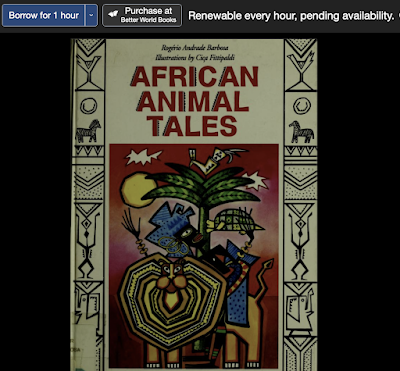
It's time for a new week of trickster stories, and I've been missing the Tortoise, so it will be a week of Tortoise stories. I'll start with the book we just finished for Anansi Book Club this week because it features several great Tortoise stories: African Animal Tales by Rogério Andrade Barbosa (translated by Feliz Guthrie) and illustrated by Ciça Fittipaldi:


For background information, you can read the book club post. The first Tortoise story in the book is The Tortoise and the Leopard, and of course it is always satisfying to see Tortoise tricking Leopard, as happens in this story:


Next up is The Cunning of the Tortoise, and it combines some of my favorite trickster motifs: trickster haunting the market, trickster making the other animals dance, and also the trickster's revenge on their accuser, in this case Tortoise gets revenge on Monkey. Here is the dancing: even the pangolins are dancing!


Last up is The Tortoise and the Jackal, which is about a wonderful trick the Tortoise plays in order to a win a contest that involves eating something very VERY hot.


This book refers to the tortoise as "she," but I think that is the gendered animal name from Portugese, tartaruga, sneaking into the English text (the author of the book is Brazilian, and his Portuguese text has been translated into English... and later this week I'll have something to say about trickster tortoises from South America too! Meanwhile, enjoy this book, and the lovely art too!

by Rogério Andrade Barbosa