Showing posts with label IAAW28. Show all posts

Friday, November 26, 2021

Africa at the Internet Archive: Spreadsheet

Each week on Friday, I'll update my progress on the story-linking project at the Internet Archive. To find out more about this project, see the first post: Starting the Spreadsheet. I'll also be using spreadsheet as a post label so that you'll be able to find all the spreadsheet posts together.

I reached my goal for this week, which was to have 5000 stories indexed and linked to the Internet Archive. You can access the list of stories and links here: African Folktales Spreadsheet. I also updated the overview with information about just which rows I added in the latest update.


As you can see there, I've indexed 174 books and articles, and there are still many more to come. 

Here are just a few of the books that got added in this latest update, each of which is just a click away at the Internet Archive, thanks to the power of Controlled Digital Lending! The links below go to the blog posts that I've written about these books previously:

by Harold Courlander and Ezekiel Eshugbayi


Thursday, November 25, 2021

Africa at the Internet Archive: Life of a South African Tribe

I'm carrying on today with public domain books that have been re-cycled into more modern books, this time with a South African collection that plays a part in a trickster tale anthology, both of which are available at the Internet Archive, just a click away.

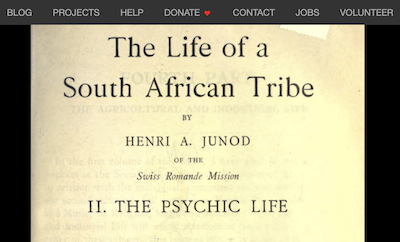
The public domain book is The Life of a South African Tribe by Henri-Alexandre Junod.


Junod was a Swiss-born missionary who spent several decades in South Africa around Limpopo, in the northern part of the country bordering on Botswana, Zimbabwe, and Mozambique. He arrived in Africa in 1889 at the age of 26, and returned to Switzerland in 1921, and during his retirement (he died in 1934), Junod published a series of books, a few of which, like this one, are available in English. You can find out more at Wikipedia.

As you can see, the cycle of "trickster hare" stories is an important part of Junod's book, and some of the material he collected inspired one of the stories in this modern anthology of trickster stories: Trickster Tales: Forty Folk Stories from Around the World by Josepha Sherman.


The collection opens with stories from Africa, and there are five different African tales drawing on a variety of sources (see notes in the back of the book for details). Here are the stories you'll find in Sherman's book: Why Anansi Owns Every Story, Hare and Tortoise, Glara Saves His Sons, Tortoise's Debt and Pig's Grunt, and Hlakanyana, plus stories about Anansi and Compere Lapin (Brer Rabbit) in the Americas section too!

The illustrations are by David Boston; here you can see Hare tying a hoe to Lizard's tail:


This is a wonderful book, and it is just one in a series of storytelling books from August House Publishers (one of my favorite publishers!), many of which you can find at Internet Archive; here's a search for August House. So many fun books to read and enjoy:


Sometimes people have a little more time for reading and relaxing around the holiday season, and if you are looking for books to read, you will find an unlimited supply awaiting you at the Internet Archive...


by Henri-Alexandre Junod


Wednesday, November 24, 2021

Africa at the Internet Archive: The Shilluk People

For today's post, I'll be looking at another public domain book, and I'll also share a more recent book that re-uses material from the public domain book, both just a click away at the Internet Archive. :-)

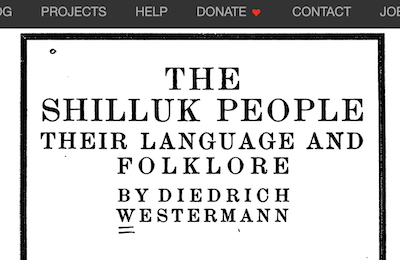
The public domain book is Diedrich Westermann's study of the Shilluk people of the southern Sudan: The Shilluk People, Their Language and Folklore, published in 1912.


You can find out more about the Shilluk people at Wikipedia.

The folklore section contains an extensive collection of myths and tales along with songs and also riddles! Here is a list of the story titles and links that take you straight to that page at the Internet Archive: Nyikang's Parents (2 versions) / The Origin of the Shullas / Early Wanderings of Nyikang / Different Doings and Adventures of Nyikang / The Man who sacrificed himself / Nyikang and the River-people / The Lost Cow / The Liar / Nyikang's Quarrel with Duwat / The Fish Ocholo / Nyikang and the Sorcerers / A War against Turtles / Praising Nyikang / The Cruel King / King Nyadwai trying the Sorcerers / The Vision of the Sorcerer / Agok / The Creation of Man / Hare and Hyena / Monkey and Lion / Dog and Fox / Hare and Hyena (again) / Lion and Fox / Starling and Centipede / Hare and Tapero / Who is King / The Hare / Camel and Donkey / The Country of the Dogs / Akwoch / Girl and Dog / Anyimo and the Lion / An Adventure in the Forest / Boy and Hyena / Nyajak / Ajang / The Snake / The Crocodile Hunter / The Travellers / A Goat-story / The Glutton / Bachet / The Country where Death is Not / The King and the People / Wealth cannot be imitated / Increase of Cattle / The Haughty Prince / The Hyena with the Bell / Elephant Hunting / A Journey.

You can find the cycle of stories about King Nyikang featured in this Jungian analysis from 1966: Lord of the Four Quarters: Myths of the Royal Father by John Weir Perry:


Perry's book is an item in the series "Patterns of Myth" edited by Alan Watts, and Watts wrote the introduction to this volume. Other books in the series include: Alpha: The Myths of Creation by Charles H. Long, The Wisdom of the Serpent: The Myths of Death, Rebirth and Resurrection by Joseph L. Henderson and Maud Oakes, and The Two Hands of God: The Myths of Polarity by Alan W.Watts, all three of which are available at Internet Archive also, just a click away.


So, if you have some extra time for reading over the holidays, an endless supply of wonderful folklore and mythology books await you at the Internet Archive. You can find all the African folklore books featured here in a single list at this page: Featured Books. Enjoy!

by Diedrich Westermann


by John Weir Perry:


Tuesday, November 23, 2021

Africa at the Internet Archive: Werner and Carpenter

Carrying on with public domain books for the month of November, I wanted to focus today on Alice Werner who was a scholar of Bantu languages; she was born in 1859 and died in 1935. Her first trip to Africa was in 1893 when she was 24 years old, and the study of Africa and African languages occupied the rest of her life. She taught at the School of Oriental Studies in London from 1917 until her retirement in 1930. For more, see Wikipedia.

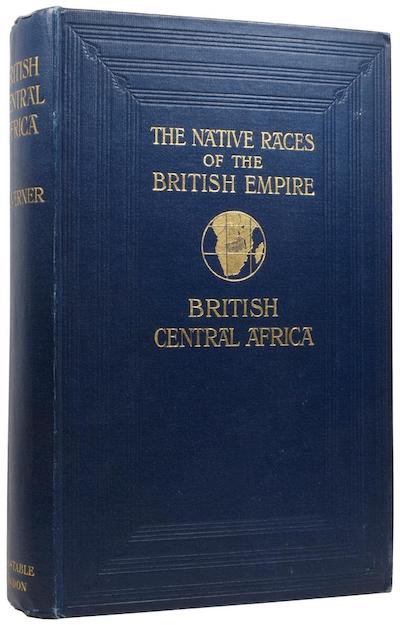
Here are three of Alice Werner's books in the public domain that you can find at the Internet Archive


The series title of that book is a good reminder of the role that linguists played in the British imperial project: The Native Races of the British Empire.

One of my themes this month is the way that public domain books have provided material for later books, especially children's books, and that is the case here; you will find a version of Alice Werner's story about the Grateful Python in a book of stories for children by Frances Carpenter: African Wonder Tales.


In Carpenter's book, the story appears as Pemba and the Python and the Friendly Rat. The illustrations are by Joseph Escourido; here is the friendly rat of the story's title:


Carpenter was a folklorist and author (more info at Wikipedia), and her book is especially useful because most of the sources that she relied on were French rather than English, so you will find stories here that you will not find in other story collections. You can find a list of sources in the acknowledgments page at the front of the book, and here is a list of the stories linked to specific pages at the Internet Archive: The Boom-boom-y Beast / Clever Kadra / The Tortoise and the Magic Drum / Who Can Break a Bad Habit? / Two Ways to Count to Ten / The Little Black Men and the Honeybees / A Dream of the Sphinx / The Monkeys and the Little Red Hats / The Girl Who Lived With the Gazells / The Battle Between the Birds and the Beasts / Strange Men With Tails / The Two Rascals / Pemba and the Python and the Friendly Rat / Polo, the Snake-girl / Omar's Big Lie / The Young Hunter and the Juju Man / The Jinni's Magic Flute / The Proud Camel and the Rude Monkey / The Bride Who Melted Away / Bomba, the Brave / The Bird That Would Not Stay Dead / The Six Horsemen / The Cannibal and His Sweet Singing Bird / The Enchanted Tortoise.

So, you can explore Werner's book and also Carpenter's children's book at the Internet Archive; they are all just a click away! And, if you're curious, there are more books by Frances Carpenter at Internet Archive also, including South American Wonder Tales, Tales of a Korean Grandmother, and Wonder Tales of Dogs and Cats, to name just three. :-)

by Frances Carpenter


Monday, November 22, 2021

Africa at the Internet Archive: Congo Life and Folklore

I'm carrying on with public domain books this month, and today I have a public domain book of stories from the Congo which inspired a children's book, both of which are just a click away at the Internet Archive.

The public domain book is a collection of stories by John Weeks, who was a missionary among the Bakongo people. The book is in two parts: the first part is a narrative of his missionary work (and also includes some stories), and the second part is a collection of stories: Congo Life and Folklore.


Also, as you can see, the book was also published under the title Congo Life and Jungle Stories.


Here is a list of the stories from both parts of the book, linked directly to pages at the Internet Archive: How the Sparrow Set the Elephant and the Crocodile to Pull Against Each Other / The Four Fools / How the Squirrel Won a Verdict for the Gazelle / How the Fox Saved the Frog's Life / Why Inquiry Should Come Before Anger / The Four Wonders / The Adventures of the Twins / Appearances Are Sometimes Deceptive / How the Fowl Evaded His Debt / Why the Small-ant Was the Winner / How the Animals Imitated the Gazelle / Why the Fowls Never Shut Their Doors / Why the Dog and the Palm-rat Hate Each Other / The Leopard Boils His Mother's Teeth / How the Ants Saved the Partridge's Eggs / The Leopard Sticks to the Wooden Image / How the Mouse Won His Wife / The Gazelle Outwits the Leopard / The Gazelle Punishes the Palm-rat / How the Crow Cheated the Dove / How the Civet and the Tortoise Lost Their Friendship / The Water-fairies Save a Child / How the Squirrel Repaid a Kindness / The Kingfisher Deceives the Owl / How the Tortoise Was Punished for His Deceit / How the Frog Collected His Debt From the Hawk / How a Child Saved His Mother's Life / How the Gazelle Won His Wife / The Gazelle Is at Last Punished / The Leopard Pays Homage to the Goat / Why the Owls and the Fowls Never Speak to Each Other / How the Elephant Punished the Leopard / How the Leopard Tried to Deceive the Gazelle / The Story of Two Young Women / Why the Chameleon Cut Off His Own Head / Why the Congo Robin Has a Red Breast / The Leopard Tries to Steal the Gazelle's Wife / The Gazelle Kills the Flies and Mosquitoes, and Outwits the Leopard / The Leopard Is Badly Tricked by the Gazelle, Rat, and Frog / Why the Small-ants Live in the Houses / The Son Who Tried to Outwit His Father.


The illustrations are by Cindy Douglas; here are crocodile and elephant pulling against each other:


This was a fun story to see as a children's book! It is one of the most popular of the African trickster tales, with various animals playing the role of trickster, like sparrow here, and various animals who tug against each other, like elephant and crocodile here. This popular African folktale was popular among African American storytellers also; here's an example from a wonderful collection of Gullah folktales at Internet Archive: Bo Rabbit Smart For True by Priscilla Jaquith, with art by Ed Young. 


Here Rabbit tricks Elephant and Whale into playing tug-of-war:


So, you can enjoy these children's books at Internet Archive, and also find many more folktales from the Congo in Weeks's book, both just a click away.


by John Weeks

Sunday, November 21, 2021

African Folktales at Internet Archive: Spreadsheet

I've got something different to share today here, which is a work in progress: a spreadsheet listing African folktales with links to the specific pages of books and articles at the Internet Archive. I hope you will find it useful!

Right now there are appx. 3800 stories linked there from appx. 140 sources, and I'm adding more each day; I'll provide updates here periodically about my progress. Here's the spreadsheet: African Folktales at the Internet Archive.

As you can see it has an overview sheet with some basic information, and then a sheet with the story links.


This is a copy of a spreadsheet that I'm using for my own purposes where I have additional columns for the project-specific information I'm tracking about these stories. I'll be adding some of those other columns to the public spreadsheet later; for right now, I'm just focusing on the basics in this public version: title of each story, title of the book it comes from, plus a link to that page at the Internet Archive. There's also a column that lets you sort the stories based on the order in which they appear in the book. To sort the books in order like that, sort first on the seequence column, then sort by author/title. That will give you a sheet sorted by book and in order within each book.

More about the Internet Archive links

Some of the stories are in public domain books which are always available at Internet Archive, while other links go to pages in books that are available with Controlled Digital Lending. With CDL, you just need to log in with your Internet Archive account (free! yay!) and then you can click the blue "borrow" button to access the book for one hour (renewable if no other patron is requesting that book). After you click on the borrow button, it will return you to that same page, automatically, so everything really is just a click away!


I've been admittedly inconsistent with the view style used for the links: some of the pages are in single-page view, others are two-page view, and many of the links are in full-screen (theater) view. You can always adjust that view  yourself using the options at the bottom of the Internet Archive browser.


Once of the best things about Internet Archive is that each of these pages, and even each view-style, is part of the URL, which means you can create bookmarks like this, page by page.

If the book you are viewing is in the public domain, that means you can also download your own PDF copy of the book; just use the download options in the lower right-hand portion of the screen, below the book viewer.

More about the spreadsheet

Anyone can view the spreadsheet online, and also search and sort, without being logged in at Google. 

You can even create your own filter views. For example, if you want to create a spreadsheet view that has stories with the word "spider" in the title, you can do that! Eventually I hope to add a keywords column that will help in creating more accurate filter views; titles are not the most reliable representation of a story's contents... but it's better than nothing! So, for example, spider:


If you've never worked with data filter views in Google Sheets, here are some tips: Sort and Filter Your Data.

To make your own copy so that you can add additional columns of your own, edit the contents, etc., you'll need a Google account; if you are logged in at Google, you will see the "copy" option under the File menu.

Final thoughts...

I'm hoping people will find this useful; it just takes a few minutes for me to paste the contents of my own spreadsheet to this public spreadsheet to share with others. I've reached this "linking" phrase of my own research, and I will have many more links to share in the next couple months — several hundred more sources at Internet Archive and thousands more stories!

And if you're a teacher, just think of how powerful this can be for your students: you can create a spreadsheet of your own recommended readings with links to the Internet Archive like this. Even better: you can make your students co-editors of the spreadsheet, inviting them to help you develop your "online class library," while also teaching them some valuable digital skills. You might need to show them just how to use a spreadsheet along with some guidance in parsing the Internet Archive URLs, but that's class time well spent in my opinion because students can then apply these same skills to other projects of their own.

Yes, I LOVE SPREADSHEETS. Can you tell? Simple databases for specific projects: no programming required. :-)