Showing posts with label IAAW42. Show all posts

Friday, March 4, 2022

African Diaspora at the Internet Archive: Spreadsheet (4)

Well, it's already "Spreadsheet Friday" again; I didn't get as much done this week as I had hoped (see why below!), but I did add new stories to the African Diaspora Folktale Spreadsheet, so there are now over 3500 stories indexed there:


And, of course, the big African Folktale Spreadsheet is available also, with over 10,000 stories there.

As I've explained in previous spreadsheet posts, you can search, sort, and filter this public sheet using all the usual Google Sheet features, and you can also make a copy of the sheet if you want to add your own columns, etc. 

The reason why I didn't get a lot done on the spreadsheet this week is that I have moved into intensive editing mode on the Reader's Guide to African Folktales at the Internet Archive, which is based on those months of blogging here about African folktales. I hope to get this book published by the end of the month, and today I finished the crossindexing, so there are now useful threads for people to follow that lead from one book entry to another book entry that has something in common; you can see how that works in the current draft: Reader's Guide.

Hopefully all the things I've been learning from this book project will help me to do a good job with the Reader's Guide to African Diaspora Folktales at the Internet Archive when the time comes! From the sheer optimism that comes from a productive week, I created a book cover for that project too. Admittedly, I don't have a lot of book covers there (yet!), but it's early days: still lots more books to blog about here and then to add to the collage. :-)


Thursday, March 3, 2022

African Diaspora at Internet Archive: Terrapin's Pot of Sense

And since I wrote about Harold Courlander's big African American Anthology and his Haitian storybooks in yesterday's blog post, I didn't want to neglect this fantastic book of African American stories from the United States: Terrapin's Pot of Sense.


This is actually one of my very favorite African American story collections. It has 31 stories, and the title story, "Terrapin's Pot of Sense," is an American version of the famous African story told about both Tortoise and Anansi where the trickster has decided to gather up all the wisdom in the world and greedily keep it for himself. (Needless to say, this plan does not succeed.) As in Courlander's many African story collections, there are notes in the back about the stories which do a great job of pointing out the African origins of the stories and also world folklore parallels.

Here is a list of the story titles linked to their Internet Archive page; it's a mix of animal stories and also stories about people: Waiting on Salvation / Reform Meeting / Rabbit, Fox, and the Rail Fence / Buh Rabbits Tight Necktie / Terrapins Pot of Sense / Slow Train to Arkansas / Buh Rabbit's Human Weakness / Buh Rabbit's Big Eat / Buh Fox's Number Nine Shoes / Buh Rabbit's Tail / The Well / Rabbit Scratches Buh Elephant's Back / Buh Mouse Testifies / Buh Rabbits Graveyard / Buh Rabbit and the King / The Texas Sandstorm / Hot Times / The Champion / The Skull / Old Master and Okra / The Do-all Ax / The King and Kuffie / Old Boss, John, and the Mule / Crossing the River / Old Boss and George / Devil in Church / Preacher and the Devil / What the Preacher's Talking About / Sharing the Crops / Death and the Old Man / The Moon's a Woman.

The delightful illustrations are by Elton Fax, an African American artist born in 1909 whose great success as an illustrator paved the way for later artists like Jerry Pinkney and others. You can read more about his life and career (he went to high school with Cab Calloway!) in this Wikipedia article. Here's his illustration of Buh Bear and Buh Fox:


You might remember Elton Fax as the illustrator of many of Verna Aardema's early collections of African folktales, like Tales from the Story Hat; just look at Buffalo and Hyena here! 


Harold Courlander and Elton Fax were both giants of their time, and I am so glad that there are LOTS of their books that you can  find at the Internet Archive... and Terrapin is a great place to start exploring!


by Harold Courlander


Wednesday, March 2, 2022

African Diaspora at Internet Archive: Harold Courlander

Today just ran away from me, and I'm just now getting around to today's post... and I thought since I wrote about Daryl Dance's anthology of African American folklore last week, I should say something about this anthology by Harold Courlander: A Treasury of Afro-American Folklore.


You can get a sense of the scope of Courlander's book from the subtitle: The Oral Literature, Traditions, Recollections, Legends, Tales, Songs, Religious Beliefs, Customs, Sayings and Humor of Peoples of African Descent in the Americas.

So, what makes Courlander's collection distinctive is all the material he has included from the Caribbean, and especially from Haiti. 

Courlander also published these two books about Haitian folk culture:


And, of course, you might remember the MANY books Harold Courlander wrote about African folklore; you can see a list of all the blogs post about his books here: books by Harold Courlander.

So, if you have a special interest in the variety of African traditions in the Americans, including the Caribbean, then Courlander's books are a great resource, and they are just a click away at the Internet Archive.


by Harold Courlander


Tuesday, March 1, 2022

African Diaspora at Internet Archive: Days When the Animals Talked

Black History Month is over for this year... but there are still lots of wonderful African American books from the Internet Archive that I want to feature here at the blog, and the book for today is one of my very favorite Brer Rabbit story collections: The Days When the Animals Talked: Black American Folktales and How They Came to Be by William J. Faulkner.


The book is divided into two parts: there are 11 stories from slave times, followed by 22 animal stories, most of them featuring Brer Rabbit. Here are the titles linked to their page at the Archive: Simon Marries Ellen / Simon Challenges the McCrackens / Fishing With Bare Hands / Simon and the Pater-rollers / How the Slaves Helped Each Other / Simon Sees a Ghost / The Ways of a Witch / How the Slaves Worshipped / A Slave's Escape / A Riddle for Freedom / Brer Rabbit Goes A-Courting / Brer Wolf's Magic Gate / Brer Bear Gets A Taste Of Man / Brer Tiger And The Big Wind / Brer Rabbit Keeps His Word / Brer Possum And Brer Snake / Brer Wolf Plants Pinders / Brer Wolf's Second Pinder Patch / Brer Fox Tries Farming Too / Brer Fox Tries Farming Too / Brer Rabbit's Protest Meeting / The Tar Baby Tricks Brer Rabbit / Run, Brer Gator, Run! / Brer Rabbit And Brer Cooter Race / Brer Fox Meets Mister Trouble / Brer Wolf Wants The Honey / Brer Rabbit Dances For A Wife / Brer Rabbit And His Riding Horse / How The Cow Went Under The Ground / Who Stole Brer Gilhard's Sheep / Brer Wolf And Brer Fox Get A Big Surprise / Brer Rabbit Rescues His Children / Who Got Brer Gilyard's Treasure?

The illustrations are by Troy Howell, and you can see there on the cover of the book, Brer Rabbit is a Black man! (Look at the hands holding the pipe.) Here's Howell's illustration for the famous folktale of Brer Rabbit making Brer Wolf his riding horse:


William Faulkner, who was born in 1891 in South Carolina, heard these stories from Simon Brown, who has a historical marker in Society Hill in Darlington County, South Carolina (Historical Marker Database) which reads: "A former slave from Virginia, Brown lived in Society Hill around 1900 and for years was employed by Lawrence Faulkner's widow to work on her farm. His small house was adjacent to the Faulkner house on this site. A gifted story-teller of black folk tales, Brown's allegories were posthumously recorded by the Smithsonian Institution."


William Faulkner has a historical marker of his own; it's located on the Fisk University campus in Nashville, Tennessee (Historical Marker Database). It reads: "William J. Faulkner. 1891-1987, a Congregational minister, folklorist and author, lived at this site from 1935 to 1947. He served as Fisk University's Dean of Men from 1934 to 1942 and as Dean of the Chapel from 1943 to 1953, During his tenure, he reorganized the Fisk Union Church into a Congregational Church structure. In 1942, Faulkner also served as the President of Nashville's NAACP."


So, if the only Brer Rabbit stories you've heard are the ones recorded by Joel Chandler Harris, attributed to a fictitious "Uncle Remus," I hope you will take a look at this beautiful collection of stories as told by the very real Simon Brown.

by William J. Faulkner


Monday, February 28, 2022

African Diaspora at Internet Archive: Daryl Dance Anthologies

Last week I wrote about Daryl Cumber Dance's Folklore from Contemporary Jamaicans, and I promised a follow-up post with some more of her books, which is also a perfect way to end Black History Month, with two fantastic books on African American folklore. You can find both of these books at the Internet Archive, just a click away:


As you can see with Shuckin' and Jivin', Dance is a folklorist who puts a high priority on contemporary folklore, just as she did with the book of contemporary Jamaican folklore. It includes etiological stories, tales of heaven and hell, ghost tales, conjure tales, stories about religion, self-degrading tales, stories about white women and black men, more tales about women, stories of marital infidelity, ethnic jokes, tales about the cruelty of whites and outsmarting whitey, stories of bad motherfuckers, animal tales, and risqué tales.

Meanwhile, From My People is a monumental anthology (800 pages long), which includes a whole range of traditional African American folklore: folktales; folk music, including blues, ballads, zydeco, rap; folk arts, including sculpture, pottery, dolls, graffitti; sermons and speeches; family folklore and memorates; soul food; proverbs; rhymes, work songs, and shouts; riddles and other verbal contents; superstitions and folk beliefs; the rumor mill, and techlore. (You can see her interest in the contemporary there in that last chapter!)

As such, this book, published in 2002, can take its place with pride alongside some of the other African American folklore anthologies, like Bontemps and Hughes (1958), Brewer (1968), and Courlander (1996), all of which are available at the Internet Archive also.


So, for Black History Month, and every month, the Internet Archive is there for you with beautiful folklore resources, all just a click away thanks to the power of Controlled Digital Lending.

Sunday, February 27, 2022

African Diaspora at Internet Archive: More Virginia Hamilton

Before Black History Month ends, I wanted to make sure to share two more books by Virginia Hamilton here. The first is a wonderful re-vision she has done of a book of folktales first published in the 19th century: When Birds Could Talk and Bats Could Sing: The Adventures of Bruh Sparrow, Sis Wren, and Their Friends.


The stories in this book come from Martha Young's Plantation Bird Legends, published in 1868. Young was a folklorist in Alabama, and a publisher of books in dialect, much like Joel Chandler Harris's "Uncle Remus" books. In the same way that Julius Lester tackled the problem of Harris with his wonderful Brer Rabbit books, I am really glad that Virginia Hamilton has done the same here with Martha Young's stories; I'll have more to say about Martha Young in a later post when I get around to addressing the legacy of dialect writing by white authors in the American South.


This book has illustrations by Barry Moser, one of Hamilton's regular collaborators. There are some beautiful two-page spreads like this illustration for the hummingbird's story:


The other book is an anthology of folktales, legends, and true stories: Her Stories: African American Folktales, Fairy Tales, and True Tales.


This book has illustrations by the great Leo and Diane Dillon, also frequent collaborators with Hamilton. This is their illustration for the famous story of the talking eggs:


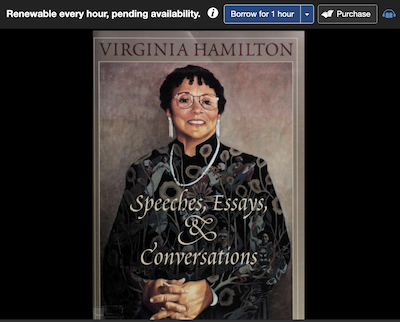
Finally, there is also a collection of Hamilton's writings about her writings: Virginia Hamilton: Speeches, Essays, and Conversations.


Of course, this is all on top of all the other books by Virginia Hamilton that I've shared previously at this blog; you can see all the posts about Virginia Hamilton together on one page. Thanks to the power of the Internet Archive and Controlled Digital Lending, these wonderful books are just a click away: