Showing posts with label IAAW49. Show all posts

Friday, May 6, 2022

African Diaspora at the Internet Archive: Spreadsheet (11)

I've crossed a new threshold for the African Diaspora spreadsheet: there are now over 7000 items from 108 different sources linked from the spreadsheet to the pages of books at the Internet Archive, everything just a click away! You can find it all at the African Diaspora Folktale Spreadsheet.


And, of course, the big African Folktale Spreadsheet is available also, with over 10,000 stories there. You can find out more about how the spreadsheets work here.

Helen Nde and I are wrapping up our first week of the ABC Anansi Book Club. Here's some information about the May books, and you can find more information at the Anansi Book Club website. 

Our first book was Aardema's Who's in Rabbit's House, illustrated by Leo and Diane Dillon. Here's a blog post about it, plus a Twitter thread I wrote over the week.


Thursday, May 5, 2022

African Diaspora at Internet Archive: Joel Chandler Harris

I'll finish up this series of posts about Joel Chandler Harris with a link to this valuable compendium: The Complete Tales of Uncle Remus by Joel Chandler Harris, edited by Richard Chase.


This massive book, over 900 pages, contains all the stories from the folktale books that Harris published: His Songs and Sayings (with its 34 stories), Nights with Uncle Remus (with 70 stories), Uncle Remus and His Friends (24 stories), Daddy Jake the Runaway (14 stories), Told by Uncle Remus (17 stories), Uncle Remus Returns (6 stories), Uncle Remus and Brer Rabbit (6 stories), Uncle Remus and the Little Boy (6 stories), plus 7 stories that Harris left in draft form but which he never published: Mr. Crow and Brother Buzzard, Mr. Goat's Short Tail, The Baby and the Punkins, Brother Rabbit's Barbecue or How Brother Bear Exposed, Brother Rabbit at the Barbecue, Brother Bear Learns to Comb His Head, Why the Bear Is a Wrestler, and Brother Rabbit Doesn't Go to See Aunt Nancy (and yes, "Aunt Nancy" is an echo of Anansi, the spider trickster of western Africa).

I've done a listing for this book that includes brief summaries for all the stories; you can see that here: Complete Harris with summaries. For each of those stories, I've also provided a link that takes you to my edited-down version of the story where I've removed the Uncle Remus framework and also the eye-dialect spelling style.

Chase's book includes artwork from the various artists who illustrated Harris's books, and you can also find some Flickr albums with public domain illustrations here: Brer Rabbit Illustrations. There illustrations from 20 different Joel Chandler Harris books there (some books were published with illustrations by different artists).


So, if you are curious about the illustrations, especially the color illustrations (Chase's book is black-and-white only), then poke around there in the Flickr albums to see what you find. Most of those images come from pages of the books at the Internet Archive! 

I also made a widget that randomizes the illustrations, and links each illustration to its story source; just reload to see an image at random, or click on the "more information" link to go to that particular story.


I should also note that Richard Chase, the editor of the book, is an important American folklorist, and you can find out more about his life and work at Wikipedia. The Internet Archive has many of his books too:  folklore books by Richard Chase (I've alerted the nice people at the Archive about the wrong Wikipedia link there for the author's identity).


It's all just a click away at the Archive, thanks to Controlled Digital Lending.

by Joel Chandler Harris


Wednesday, May 4, 2022

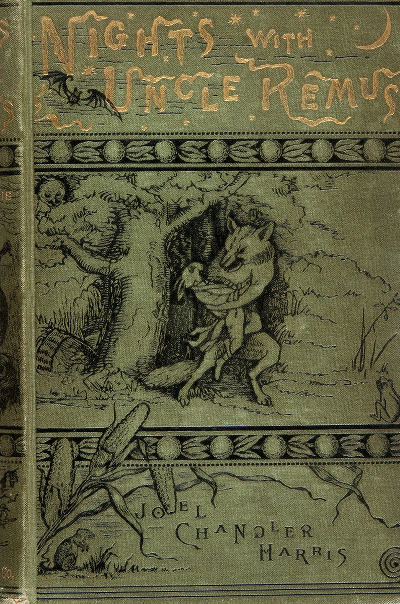
African Diaspora at Internet Archive: Nights With Uncle Remus

Yesterday I wrote about Joel Chandler Harris's first book of Brer Rabbit stories, published in 1881. Today I want to write about the second volume of stories that he published, and it is the one that is both the longest and also the most important in terms of its contribution to 19th-century African American folklore: Nights With Uncle Remus: Myths and Legends of the Old Plantation, published in 1883 (and yes, you can see there that the woman Brer Rabbit courting is white; see yesterday's post for more about that).


As you can see, it's a big book, nearly 500 pages long as originally published, and it contains 70 stories, along with a length introduction by Harris, along with comparative notes on African parallels to the stories and also Brazilian parallels, as well as parallels to Creek and other Native folktales, although Harris argues strongly for the African origins of the stories, considering the African American stories to have passed to the Creek storytellers, rather than the reverse (and for more on that, see Monday's post on African American and Native American intertwined storytelling traditions: When Brer Rabbit Meets Coyote).

In addition, Harris includes some stories told in Gullah in this collection, introducing a new narrator, Daddy Jack, who visits the plantation where Uncle Remus lives; unlike Uncle Remus, Daddy Jack was born in Africa. Just as Harris was proud of his use of eye-dialect to convey the African American dialect spoken in Georgia, he aspired to write down the Gullah stories accurately, and as such these texts have some historical value in attempting to reconstruct the use of Gullah in the latter part of the 19th century. Here is the start of Daddy Jack's story of Brer Rabbit and Brer Gator:


As with Harris's first book, I have completed a version of these stories with the racist Uncle Remus frametale material removed, along with the excess of eye-dialect, and I also wrote brief summaries of each story; you can find all that here: Nights with Uncle Remus (de-Remus-ified).

The illustrations are by Frederick S. Church and William Holbrook Beard, and the ones by Beard are really well done (Church was one of the illustrators of Harris's first book). Here, for example, is Brer Rabbit with Sis Goose:


There is also a later edition of this book illustrated by Milo Winter; you can see those illustrations here. Some are in color; I really like this one of Possum and Weasel!


But of course none of the Brer Rabbit illustrators can come close to the work that Jerry Pinkney has done, so, as always, I would urge people to read Lester and Pinkney's version side by side with Joel Chandler Harris and his various illustrators. Here's Lester and Pinkney: Uncle Remus: The Complete Tales.

It all awaits you at the Internet Archive, thanks to Controlled Digital Lending.

by Joel Chandler Harris


Tuesday, May 3, 2022

African Diaspora at Internet Archive: Uncle Remus - His Songs and Sayings

As I mentioned in yesterday's post about Brer Rabbit and Coyote, this week is probably as good a time as any to tackle the legacy of Joel Chandler Harris. For many readers, Harris's books of stories told by "Uncle Remus" defined the horizons of African American storytelling, and in a deeply racist way. Although Harris (see Wikipedia) did collect actual stories from African American storytellers and considered himself a sort of amateur anthropologist, he totally appropriated the stories for his own literary purposes, putting his name front and center, building his reputation and his fortune with the stories of Black storytellers, writing with only white audiences in mind.

So, insofar as Harris's books do provide indirect evidence of African American storytelling traditions in the 19th century, they are of great value, but they cannot, and should not, stand on their own. We need to separate the stories from Harris's racist project of sentimentalizing slavery and then re-locate the stories in the larger African American storytelling tradition (hence this blog).

As part of that process of liberating the stories from Harris's plantation fantasy, I have re-edited the stories in order to strip out the Uncle Remus frametale, and also to reduce the use of eye-dialect. You can see the result here: Brer Rabbit, Tales of a Trickster. In that blog, you'll find all 184 of Harris's stories retold; see the right-hand sidebar of the blog for the links, story by story, book by book.

Harris's first book was Uncle Remus: His Songs and Sayings, published in 1881. The book contains folktales plus proverbs and songs, and then the "sayings" of Uncle Remus which are Harris's own fictional stories, his sentimental fantasies about plantation life. (As Harris himself explains in the introduction to the book, his imaginary Uncle Remus "has nothing but pleasant memories of the discipline of slavery.")


The first edition features illustrations by F. S. Church and J. H. Moser, and they draw the human characters, besides Uncle Remus, as white. Just as Remus's audience is a little white boy, the illustrators imagine the readers of the book as white, which is then reflected in their illustrations. Here you can see Brer Rabbit and Brer Turtle with the "gals" for example, and they are shown as white:


For a listing of the stories with summaries of each one, plus a link to the version in Julius Lester's version of the stories, see this page: Uncle Remus Index. Julius Lester's version of the stories also removes the Uncle Remus frame and retells the stories much more freely, seeking to connect with young readers of today... plus it has beautiful illustrations by Jerry Pinkney! Lester did not follow the order of Harris's books; instead, he put the stories in his own order. So, the stories from this book of Harris appear in Lester's Tales of Uncle Remus, More Tales of Uncle Remus, Further Tales of Uncle Remus, and Last Tales of Uncle Remus, all of which are bound together in his The Complete Tales.


In Pinkney's vision of the stories, the human characters are African American, so here is his depiction of the gals from the story of Brer Rabbit and Brer Turtle outfoxing Brer Fox when they go to see the gals:


Harris's books are of historical value, to be sure, but if you are looking for a version of Brer Rabbit's stories just to read and enjoy, I'd recommend Lester's book, and it too is just a click away at the Internet Archive!


by Joel Chandler Harris 


Monday, May 2, 2022

African Diaspora at Internet Archive: When Brer Rabbit Meets Coyote

Since yesterday's post included Diaspora stories and Native stories too (J. J. Reneaux's How Animals Saved the People: Animal Tales from the South), I thought that would be a good prompt for today's book: When Brer Rabbit Meets Coyote: African-Native American Literature, edithed by Jonathan Brennan.


In the introduction, Brennan provides a detailed survey (almost 100 pages long!) of the back-and-forth between African and Native folk traditions: "Introduction: Recognition of the African-Native American Literary Tradition." There then follow two essays on African-Native American folklore:  "On the Interaction of Traditions: Southeastern Rabbit Tales as African-Native American Folklore" by David Elton Gay and "Brer Rabbit and His Cherokee Cousin: Moving Beyond the Appropriation Paradigm" by Sandra K. Baringer. The other essay sections cover captivity and slave narratives, Mardi Gras performances, and contemporary culture.

And if you are interested in learning more about the Rabbit stories of the Native peoples of the southeastern United States, this book is great place to start:


Swanton was an anthropologist who worked for the Smithsonian (more about Swanton at Wikipedia), and this book is especially valuable for the way it cites multiple versions from Creek, Hitchiti, Alabama, Koasati, and Natchez storytellers. Just look at all these rabbits!


I guess the time has come for me to start assessing the "Brer Rabbit" literature and confronting the heavy (oppressively heavy...) legacy of Joel Chandler Harris. So, if that's what's going to happen here this week, I am glad to start off with this book, as it is a powerful reminder that the interplay of Native and African stories is an essential part of who Brer Rabbit became in the folklore of the United States.

Sunday, May 1, 2022

African Diaspora at Internet Archive: How Animals Saved the People

Since I was sharing Creole tales and stories from Louisiana last week, I wanted to start off this week with a truly beautiful book of stories by Cajun storyteller J. J. Reneaux: How Animals Saved the People: Animal Tales from the South. 


You can find out more about J. J. Reneaux at StoryNet. Not all the stories here are strictly African Diaspora stories, but the creations of African storytellers are an essential ingredient in Reneaux's mix of Cajun, Creole, Native American, and European storytelling elements. Here are the stories you will find in the book: The Golly Whumper [Appalachian] ~ How Miz Gator Lost Her Pea-Green Suit [African-American] ~ How the Bear People Lost Fire [Alabama] ~ Bouki and Lapin Divide the Crops [Creole / African-American] ~ Waiting for BooZoo [African-American] ~ The Poopampareno [European] ~ Buzzard and Chicken Hawk [Cajun / African-American] ~ How Animals Saved the People [Choctaw].

Even more exciting is the fact that the illustrations are by James Ransome (more about Ransome at Wikipedia), who is a protege of Jerry Pinkney. You might remember him from his work with Donna Washington on A Pride of African Tales.

As you can see, he brings the animals beautifully to life, just as Pinkney was able to do also. Here is Rabbit about to trick Gator:


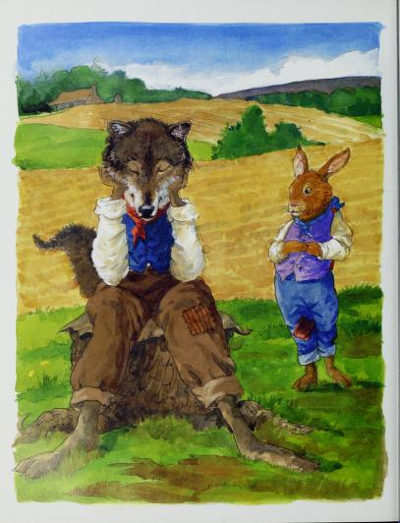
And Rabbit is also going to trick Bouki (depicted as a wolf here) when they decide to farm together:


Plus you'll find one of my all-time favorite folktales in here about the difference between Hawk and Buzzard:


So, if you are looking for a collection of stories that does justice to the different cultures of the American South, this book is a great one to read from start to finish, all just a click away at the Internet Archive. 

by J. J. Reneaux