Showing posts with label Books: Proverbs. Show all posts

Thursday, September 22, 2022

Proverbs at Internet Archive: Scottish

Here's another book in the Hippocrene proverb series (no editor's name supplied): Scottish Proverbs.

The illustrations are by Shona Grant; here's the one used for the book cover: Better be deid than oot o' fashion.

The book has only the Scottish versions of the proverbs, which isn't too difficult to figure out for English speakers, but just in case, there's a glossary in the back:


Here are some of my favorites:

  • Ne'er rode ne'er fell.
  • Better sma' fish than nae fish.
  • Illy-willy cows should have short horns.
  • Even the langest day will hae an end.
  • I theekit ma hoose in the guide weather.
  • Ne'er show your teeth unless you can bite.
  • A young saint may prove an old devil.
  • A misty morning may be a clear day.
  • A mitten'd cat ne'er was a good hunter.
  • There is mony a true tale tauld in jest.
  • Every man wishes the water to his ain mill.
  • Forbid a fool a thing an' that he'll do.
  • Tak time when time is, for time will awa'.
  • He that gets, forgets, but he that wants, thinks on.
  • It is weel said, but wha will bell the cat?
  • Enough's as good as a feast for a starvin' man.
  • Be happy while you're livin, for you're a lang time deid.
  • He has ae face to God an' anither to the de'il.
  • A day to coem seems longer than a year that's gone.
  • What may be done at any time will be done at no time.

Here's one I made into a slide in a World Proverbs slideshow:

So, have fun with these... and don't mind if the spellchecker protests the Scottish spelling!

Scottish Proverbs


Proverbs at Internet Archive: Eli

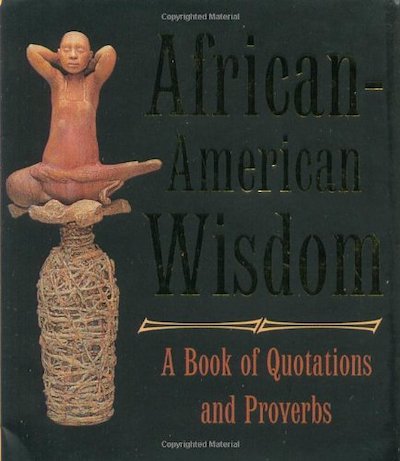
This book is a combination of traditional proverbs and quotations (far more quotations than proverbs): African-American Wisdom: A Book of Quotations and Proverbs by Quinn Eli.

Quinn Eli (who is best known as a playwright) has organized the book into five general sections: Wisdom, Identity, Achievement, Humanity, and Hope.

The book is beautifully illustrated with work by African American artists (see the list of art credits in the back), and, the quotations are credited on each page. For example, here is a painting called "Expectation" by Hughie Lee-Smith, paired with two quotations.

Here are my favorites:

  • When you clench your first, no one can put anything in your hand. [Alex Haley]
  • It's better to look ahead and prepare than to look back and regret. [Jackie Joyner-Kersee]
  • Don't hate: it's too big a burden to bear. [Martin Luther King, Sr.]
  • You may encounter defeats, but you must not be defeated. [Maya Angelou]
  • When I discover who I am, I'll be free. [Ralph Ellison]
  • Everybody hears a different drummer. [Alvin Ailey]
  • The price of your hat isn't the measure of your brain. [African American proverb]
  • A man without knowledge of himself and his heritage is like a tree without roots. [Dick Gregory]

Here's one I made into a slide in a World Proverbs slideshow:

So, enjoy the inspiring words and all the artwork too!

by Quinn Eli


Wednesday, September 21, 2022

Proverbs at Internet Archive: Kogos

Here's a bilingual book of proverbs in both Yiddish and English: 1001 Yiddish Proverbs by Fred Kogos.


There's also a pronunciation guide for the Yiddish at the start of the book. Here's how the layout looks, with the Yiddish first, and then an English translation.


When you find a keyword you're interested in, you can always use Internet Archive's search feature too. So, for example, if you are curious to find more proverbs with horses, here they are:


Here are some of my favorites:
  • Man thinks, and God laughs.
  • A child's wisdom is also wisdom.
  • One can't fill a torn sack.
  • Another's cloak doesn't keep you warm.
  • It's no crime to steal from a thief.
  • A foolish rich man is still a lord.
  • A bad peace is better than a good war.
  • The wedding jester makes everyone laugh; he alone is miserable.
  • A man should stay alive if only out of curiosity.
  • A friend you have to buy; enemies you get for nothing.
  • A curse is not a telegram; it doesn't arrive so fast.
  • A fool makes two trips where the wise man makes none.
  • An animal has a long tongue, yet he can't recite a blessing.
  • A heart is a lock; you need the right key to find it.
  • A wise man knows what he says; a fools says what he knows.
  • It's a good idea to send a lazy man for the Angel of Death.
  • A liar tells his story so often that he gets to believe it himself.
  • Man is sometimes stronger than iron and at other times weaker than a fly.
  • A rich man's fortune down and a poor man's fortune up: they are still not even.
  • A fool can ask more questions in an hour than a wise man can answer in a year.
Here's one I made into a slide in a World Proverbs slideshow:


Lots to enjoy here in both Yiddish and English!

by Fred Kogos


Proverbs at Internet Archive: Taylor & Whiting

Here is a monumental reference work for American proverbs of the 19th century: A Dictionary of American Proverbs and Proverbial Phrases, 1820-1880, by Archer Taylor and Bartlett Jere Whiting.

The proverbs are organized by keyword, with detailed bibliography for each one.

The book's preface explains the methodology they used to collect the proverbs, followed by a detailed bibliography of texts and also secondary reference works.

Here are some of my favorites:

  • Rotten apples are the sweetest.
  • A new broom sweeps clean.
  • Blackberries don't grow on every bush.
  • An empty bag can't stand straight.
  • Life lies open like a book.
  • What's everybody's business is nobody's business.
  • Our backs are fitted to our burdens.
  • Ants live safely till they have gotten wings.
  • The ass knows in whose face he brays.
  • You can't get blood out of a stump.
  • Let every man drink from his own bottle.
  • But buds will be roses, and kittens, cats.
  • Don't cross the bridge before you get to it.
  • I'll row my own boat against wind and tide.
  • He who loves not bread dotes not on dough.
  • Other men beat the bush, but you catch the bird.
  • A man who is born to be hanged will never be drowned.
  • I wasn't born in the brush to be scared of garter snakes.
  • Now the bridge that has carried me so well over, shall I not praise it!
  • We praised a bridge that carries us safe, even if it is a poor one.
  • Book-learning spoils a man if he's got mother-wit, and if he ain't got that, it don't do him any good.

Here's one I made into a slide in a World Proverbs slideshow:

Archer Taylor and Bartlett Jere Whiting are two of the leading proverb scholars of the 20th century, and this book is a fabulous reference work although, be warned, the number of "proverbial phrases" (metaphors, comparisons, other kinds of verbal cliches) outnumber the actual proverbs by far.

by Archer Taylor and Bartlett Jere Whiting


Proverbs at Internet Archive: Basset

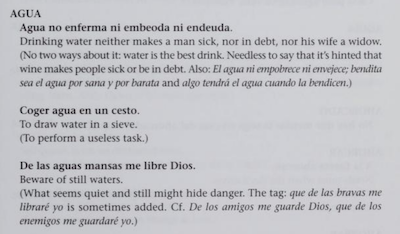
Here's a wonderful example of a truly bilingual publication: A Dictionary of Proverbs, Sayings, Saws, Adages: English and Spanish by Delfín Carbonell Basset.


It's meant both for Spanish-speakers learning about English proverbs AND for English-speakers learning about Spanish proverbs. The one thing to beware of is that this book features equivalents rather than literal translations of the proverbs in each language.

The first part of the book is for Spanish speakers. It contains English proverbs with Spanish equivalents, along with a brief commentary in Spanish. The organization is alphabetical:


The second part of the book, beginning on p. 223, reverses the order: there are now Spanish proverbs with English equivalents and a brief commentary in English for English-speakers:


Here are some of my favorites:
  • Llevar agua al río.
  • Cada día sabemos más.
  • Cada ollero su olla alaba.
  • Más vale antes que después.
  • No hay día sin lección.
  • Para aprender nunca es tarde.
  • La avaricia rompe el saco.
  • Nadie se alabe hasta che acabe.
  • Amor fuerte dura hasta la muerte.
  • Cada día se aprende algo nuevo.
  • Del árbol caído, todos hacen leña.
  • Quien acecha por agujero, ve su duelo.
  • De las aguas mansas me libre Dios.
  • Nunca digas de este agua no beberé.
  • Cuando todos dicen que eres asno, rebuzna.
  • Quien peces quiere, que se moje el culo.
  • Amigo en la adversidad es amigo de verdad.
  • Amor no respeta ley, ni obedece a rey.
  • El pez que busca elanzuelo, busca su duelo.
  • Los árboles no nos dejan ver el bosque.
  • El favo es dulce, mas pica la aveja.
  • Quien no se aventura, no pasa la mar.
  • Quien no se aventuró, ni perdió ni ganó.
  • Más vale un amigo cercano que un hermano lejano.
  • Quien de todos es amigo, de ninguno es amigo.
  • El que se acuesta en dos sillas, da de costillas.
  • Cuando Adán cavaba y Eva hilaba, la hidalguía, ¿dónde estaba?
  • Amar y no ser amado es un tiempo mal empleado.
  • Cuando carga de oro el asno lleva, sube al azotea.
  • Todos somos hijos de Adán, los de la telilla y los del tafetán.
  • De los amigos me guarde Dios, que de los enemigos me guardaré yo.
  • Al amigo que no es cierto, con un ojo cerrado y otro abierto.
  • Quien rompe una tela de araña, a ella y a sí mismo se daña.
Here's one I made into a slide in a World Proverbs slideshow:


Finally, there is a bibliography in the back. So much to enjoy here!


Tuesday, September 20, 2022

Proverbs at Internet Archive: Rivera

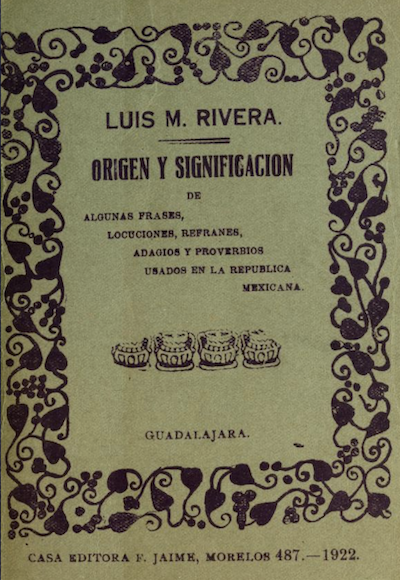
The book focuses on Mexican proverbs and sayings: Orígen y Significación de Algunas Frases, Locuciones, Refranes, Adagios y Proverbios by Luis Rivera.

The book is organized alphabetically, and each saying has a brief explanation:

Here are some of my favorites:

  • Es pintar como querer.
  • Poner cruces en ladrones.
  • ¿Estoy en un lecho de rosas?
  • Ahogarse en un vaso de agua.
  • Ahí les dejo el gallo muerto.
  • Come el burro que tocó la flauta.
  • A caballo ajeno, espuelas propias.
  • A falta de pan, buenas son semitas.
  • A caballo dado no se le ve colmillo.
  • Al mejor cazador se le va la liebre.
  • Decir las tres verdades del barquero.
  • Hágase el milagro y hágalo el Diablo.
  • A dos garrochas no hay toro valiente.
  • A cada puerco se le llega su San Martín.
  • Pagar en tres plazos: tarde, mal, y nunca.
  • ¡Qué haya un caváver más, que importa al mundo!
  • Al nopal lo van a ver, sólo cuando tiene tunas.
  • Si malo es San Juan de Dios, peor es Jesús Nazareno.
  • ¡El pan duro, duro, duro, duro / es bueno cuando no hay ninuno!
  • ¡El zapato malo, malo, malo, malo / es mejor en el pié que en la mano!
  • Se hace como los barriles de Tequila que despiden tufo aunque estén vacíos.

Here's one I made into a slide in a World Proverbs slideshow:


The book is in Spanish only, and the focus on Mexican sayings may be of special interest. 

Orígen y Significación de Algunas Frases,
Locuciones, Refranes, Adagios y Proverbios

by Luis Rivera


Proverbs at Internet Archive: Lipinski

Here's a bilingual book of Polish proverbs from the Hippocrene proverbs series: Dictionary of 1000 Polish Proverbs by Mirosław Lipinski.


The book is organized alphabetically in Polish based on a keyword in each proverb, as you can see in this screenshot:


Notice that sometimes there is an English translation, but sometimes there is an equivalent English proverb (in italics) which is not actually a translation of the Polish. That's the case for one of the apple sayings here: "Nie każde takie jabłko wewnątz jak zewnątz" translated literally would be "Not every apple is the same inside as it is outside." So, beware of the versions in italics; they are NOT necessarily even close to the Poilsh original in terms of the actual wording.

BTW: If you want a quick way to type a few words quickly in Polish without switching to a Polish keyboard, I highly recommend this great site: Polish.TypeIt.org


Here are some of my favorites (in English):
  • An empty barrel makes the most noise.
  • When poverty comes in at the door, love flies out the window.
  • The devil doesn't sleep.
  • The man has not yet been born who can please everyone.
  • The tree falls not at the first blow.
  • Yesterday is the teacher of today.
  • One today is better than two tomorrows.
  • A bell calls people to church but is never in church itself.
  • Fortune's wheel is turning.
  • As the pot, so too its lid.
  • If my aunt had whiskers, she'd be my uncle.
  • Just one fool can ask more questions than ten wise men can answer.
  • The most foolish man is the one who thinks himself wise.
  • A guest in the house is God in the house.
  • Who knows what lies beyond the mountain.
  • You have no mountain without a valley.
  • On the highest mountains the lightning strikes.
  • Don't play; you won't lose.
  • The apple doesn't fall far from the apple tree.
  • As long as there are people, there will be mistakes.
  • Man does not live to eat, but rather he eats in order to live.
  • It is a virtue above all virtues to keep your tongue behind your teeth.
Here's one I made into a slide in a World Proverbs slideshow:


I was a Polish major in college, so this book of proverbs is one that I really like, and there's a bibliography in the back if you are in search of more Polish proverbs. 

Proverbs at Internet Archive: Levin

So, the time has come to start writing about books of proverbs at the Internet Archive, because my next Reader's Guide will be a Reader's Guide to Proverbs at the Internet Archive (following the Reader's Guide to African Folktales, which I've completed, and African Diaspora Folktales, which I'm drafting right now). For each of the proverb books, I will include some basic bibliographical information about the book, along with some of my favorite proverbs.

To get things started, here's a book of Jewish proverbs which is delightfully eclectic: Where There's Smoke, There's Salmon: The Book of Jewish Proverbs by Michael Levin.


You will find ancient proverbs here and modern sayings too, each one with an attribution. The book is organized thematically, with a detailed bibliography in the back.


As you can see from the title of the book, many of the modern proverbs are what Wolfgang Mieder has called "anti-proverbs." So, instead of the usual, "Where there's smoke, there's fire." this Jewish anti-proverb is about lox instead: "Where there's smoke, there's salmon."

Here are some of my favorites:
  • Be not sweet lest you be swallowed.
  • I am very careful in the choice of enemies.
  • The world is but a narrow bridge, and the main thing is not to fear.
  • Approach a goat from the back, a horse from the front, and a stupid man from no direction whatsoever.
  • Do not boast of tomorrow, for you do not know what the day will bring.
  • When one spits upwards, it falls down on his own face.
  • One should not say with his mouth what he does not mean with his heart.
  • Do not throw stones into a well that once gave you its water.
  • The angry man fills his mouth with live coals and with needles, sharp and hard.
  • There are four types of men: one who says what's mine is mine and what's yours is yours, he is a neutral person; one who says what's mine is yours and what's yours is mine is a fool; one who says what's mine is yours and what's yours is yours is righteous; one who says what's yours is mine and what's mine is mine is evil.
  • He who digs a pit will fall in it, and whoever rolls a stone, it will roll back on him.
  • Arrogance is a kingdom without a crown.
  • Everyone must have two pockets so that he can reach into the one or the other, according to his needs: in his right pocket are to be the words "For my sake was the world created," and in his left, "I am dust and ashes."
  • We say to the bee: we want neither your honey nor your sting.
  • A schlemiel is a person who always spills his soup; a schlemozzle is the person he spills it on.
  • A sated person disdains honey, but to a hungry man anything bitter seems sweet.
  • Sugar in the mouth won't help if you're bitter in the heart.
  • Drink water from your own well.
  • Better a dry crust of bread with peace than a house full of feasting with spite.
  • Hunger dominates the world when justice is not tempered with mercy.
Here's one I made into a slide in a World Proverbs slideshow:


There's lots to enjoy here, and the bibliography gives you many leads to follow too.

by Michael Levin