Showing posts sorted by relevance for query jerry pinkney. Sort by date Show all posts

Sunday, July 4, 2021

African Folktales at Internet Archive: Adventures of Spider

It's hard to believe it's already Week 8 of this book recommendation adventure... and there are still so many books I want to recommend! This week, I'll shift over to West Africa with books that focus on the tricksters Spider (Anansi) and Tortoise (Ajapa). 

For today, it's Anansi in two books by Joyce Cooper Arkhurst with illustrations by Jerry Pinkney, both books just a click away at Internet Archive. The first book,  The Adventures of Spider: West African Folktales, appeared in 1964:
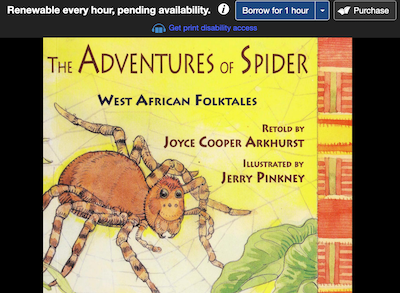

Then, there was a follow-up volume, More Adventures of Spider, which appeared in 1972:


The author of both books, Joyce Cooper Arkhurst, collected these Ananse stories in western Africa, mostly in Ghana. Here's a blurb from the back of the 1972 book with a photo. 


You might remember the illustrator, Jerry Pinkney, from last week; his beautiful art appears in a book about an east African trickster: Rabbit Makes a Monkey of Lion. Here you can see the trickster Rabbit talking with Bush-Rat and with another trickster, Tortoise:


Doing illustrations of Spider is a big challenge for artists, much more so than for other tricksters like Rabbit or Tortoise, and you can see a big shift in Pinkney's illustrations between the two books. Both books have marvelous artwork, but it's really in the later book that you see more of what became Pinkney's own distinctive style.

So, for example, here are Pinkney's illustrations for the famous story of Anansi and the pot of wisdom in the book from 1964, which was the first book that Pinkney illustrated! (You can read about his long career here at HistoryMakers and also at Wikipedia.) This is Anansi with the pot, and then Anansi trying to climb a tree so that he can hide the pot from everyone else:


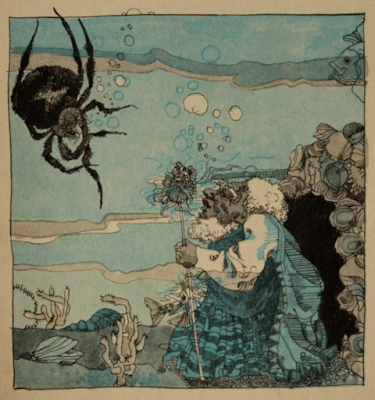
Meanwhile, these illustrations come from the 1972 book, and you can see that Pinkney had by then evolved his own beautiful, distinctive style. This illustration shows Anansi underwater as he tries to get to the island of coconuts:


This illustration is from a story about Tree Bear and Anansi taking their dispute to the chief for judgment:


Beautiful!

So, if you have heard about Anansi and were always curious just what he's all about, these two books are a great place to start. :-)


by Joyce Cooper Arkhurst
with illustrations by Jerry Pinkney


by Joyce Cooper Arkhurst
with illustrations by Jerry Pinkney

Tuesday, September 6, 2022

ABC 18: Rabbit Makes a Monkey of Lion

Because I'm out of town for about half of this month, our Anansi Book Club schedule is a little different. We're just reading three books this month, and it's already time for our second book (see the September schedule... plus you can see all the Anansi Book Club posts at this blog) — and I'm so excited about this new book because it has art by......... Jerry Pinkney! The book is Rabbit Makes a Monkey of Lion: A Swahili Tale by Verna Aardema, and it's just a click away at the Internet Archive!


I've written a lot about both the prolific author Verna Aardema (whose main focus was African folktales) and the amazing artist Jerry Pinkney at this blog; you can find all their posts with these links: Verna Aardema and Jerry Pinkney. They also collaborated on a fabulous book of riddles: Ji-nongo-nongo Means Riddles, which you can also find at Internet Archive!


The main characters as you can guess from the title are Rabbit and Lion, but Rabbit also has partners in crime. Here's Rabbit and Bush-Rat:


And here's Rabbit and Tortoise. Yes, that's right: you get two tricksters in this book. Both Rabbit and Tortoise are part of the story!


I'll have more to say in the next few days about Aardema's source for this story, and also about the folklore associated with the honeyguide bird, who is another important character in the tale. 

The source for the main part of this story is "The Hare and the Lion” in Bateman's Zanzibar Tales, and that happens to be one of the stories I included in the Reader's Guide Anthology. That book has illustrations by Walter Bobbett, but of course they are nothing to compare to Pinkney's artwork. Here's Bobbett's lion; as you can see in the caption, Bateman uses the Swahili names for the animal characters, so the rabbit is Soongoora (Sungura), the lion is Simba, the rat is Bookoo, and so on.


You can also read the Swahili version of the story that Bateman started from in Steere's Swahili Tales: Sungura na Simba / The Hare and the Lion (click on the image for a larger view):


It is always fascinating to be able to compare the source(s) that a writer uses when they retell a folktale, and in this case you can see a wonderful character that Aardema added to this story: a honeyguide bird. Since the story involves honey, adding in this character makes perfect sense, and it resonates beautifully both with the ecology and also with folktale tradition, as the honeyguide bird is a character you can find in many African folktales! More about the honeyguide bird: Meet the Greater Honeyguide, the Bird That Understands Humans.


You can also read about the honeyguide bird at Wikipedia. Here is how Jerry Pinkney draws the bird as a character in the story:


And of course this post would not be complete without a link to Jerry Pinkney's brilliant illustrations (include some amazing two-page color spreads) for Julius Lester's monumental adaptation of Joel Chandler Harris's stories, stripping out all the repugnant Uncle Remus frametale, rendering the rabbit in wonderful, readable glory. You can read all about Lester and Pinkey's Brer Rabbit here, and yes, it's available at Internet Archive: The Complete Tales.


Here's one of those two-page color spreads: wow!


So, just jump in and enjoy Aardema's version of the story AND the illustrations. It's full of classic African folktale animals and trickster motifs, and just a click away at the Archive, thanks to the power of Controlled Digital Lending!

by Verna Aardema


Thursday, August 12, 2021

African Folktales at Internet Archive: The Great Minu

This week I've been focusing on books illustrated by Diane and Leo Dillon (see the Dillons' books), and to finish up the week I'm going to shift focus to another fabulous illustrator: Jerry Pinkney. Here's today's book: The Great Minu by Beth Wilson, just a click away at the Internet Archive.


The source for Wilson's story is West African Folktales by William H. Barker and Cecilia Sinclair, a book originally published in 1917, which means it is in the public domain and widely available online, including at Internet Archive. You can compare that text of the story with the version in Wilson's book. 

The version Barker collected is very short, but easy to expand, and Wilson has added other encounters for the farmer to meet along his way, beautifully illustrated by Jerry Pinkney. So, for example, he meets a woman washing clothes:


He meets a grandmother telling stories:


But he continues on to the city, and the Accra that is shown here is a more modern Accra; for example, the farmer sees big ships in the harbor, and also an opulent hotel:


I won't spoil the surprise of what happens on his journey and what he learns (and no, the farmer is not the "Minu" of the book's title); it's a lovely story and a beautiful book. Plus, for those of you who know Jerry Pinkney from his Brer Rabbit illustrations (which are THE BEST Brer Rabbit illustrations), you will recognize his distinctive way of depicting the animals too:


I'll be back with another book illustrated by Jerry Pinkney tomorrow. Meanwhile: more about the great Jerry Pinkney: Adventures of Spider

And for a story you won't forget, take a few minutes to read this book; you can just click and read, thanks to Internet Archive:

by Beth Wilson


Thursday, July 1, 2021

African Folktales at Internet Archive: Rabbit Makes a Monkey of Lion

In yesterday's post about Bateman's Tales from Zanzibar, I wrote about how useful public domain story collections are because they provide storytelling material to inspire other storytellers and also artists, and today I get to write about one of my very favorite book illustrators, Jerry Pinkney, because Pinkney did the illustrations for a book by Verna Aardema inspired by one of the stories in Bateman's book: Rabbit Makes a Monkey of Lion: A Swahili Tale. This beautiful book is just a click away at Internet Archive:


I would have liked a book based on this story no matter who did the illustrations because this is a wonderful series of tricks and tricksters featuring both rabbit and turtle stealing lion's honey, with some help from the honeyguide bird. I don't want to spoil the twists and turns in the plot, but here you can see some of Pinkney's depictions of the main characters: rabbit and the honeyguide bird, bush-rat, turtle, and lion.


And this one is a bit of a spoiler: it shows turtle getting away from lion!


This book was published in 1989, so we can trace its publication lineage back over one hundred years, first to Bateman's book in 1901, and then to the book of stories in Swahili published by Steere in 1870; you can see Steere's literal translation of this story along with the Swahili text here: Sungura na Simba / Hare and Lion. (The hare is sungura in Swahili,  and the lion is simba.)


So, yay for the power of the public domain and also for the amazing art of Jerry Pinkney. I'll have lots more to say about Pinkney later when I move on to African American stories, as he did the very best illustrations ever done of the Brer Rabbit stories, which feature some of the same animals you see here. Enjoy!

retold by Verna Aardema
with illustrations by Jerry Pinkney


Thursday, March 31, 2022

ABC Anansi Book Club: a year of lists

I randomized the items from the Reader's Guide, and sorted them into groups, the idea being that each month we could choose 3 short books to read (one each week during the first part of the month), and then wrapping up the month with one longer book (under 100 pages, so not too long!). 

Here's how those 12 groups came out; the idea is that we've got 12 groups ready to go, and before we start up each month (with May being out first month), Helen and I will choose a group to work from and prep some materials that will help people as we make our choices! So, for example, we will get the May materials ready for April 25 or so, and then people can vote and we can start reading together in May, sharing our thoughts and ideas in a slow Twitter chat each week with the hashtag #AnansiBookClub.

You can share your ideas and suggestions about any/all of this at the Anansi Book Club planning document.

GROUP:

GROUP:

GROUP:
GROUP:

GROUP:

GROUP:

GROUP:

GROUP:

GROUP:

GROUP:

GROUP:

Sunday, March 27, 2022

African Diaspora at Internet Archive: Brian Pinkney

Since I wrote about a book illustrated by Brian Pinkney in yesterday's post, I wanted to follow up with another one of his books today: Cendrillon: A Caribbean Cinderella by Robert  San Souci.


This is from a Creole version of Cinderella, and be sure to look at the Creole glossary in the back along with the author's note about his sources.

The illustrations by Brian Pinkney are beautiful!


I also wanted to share another book that Brian Pinkney illustrated; it's not folklore, but instead poetry by Langston Hughes: The Dream Keeper and Other Poems.


You can find out more about the great poet Langston Hughes at Wikipedia; how I wish he could have lived to see this beautiful book. You might recall that I wrote an earlier post about an anthology of African American folklore that Hughes edited: The Book of Negro Folklore.

Here's Pinkney's illustration for a poem about Jim Crow and merry-go-rounds: there ain't no back / to a merry-go-round.


I think it's wonderful to see how Brian Pinkney developed his own very distinctive style, just as his father, Jerry Pinkney, developed his own style over the years (more from Jerry Pinkney).


by Robert  San Souci


by Langston Hughes


Tuesday, February 1, 2022

African Diaspora at Internet Archive: Julius Lester / Uncle Remus

I'm so excited about this post for the first day of Black History Month, 2022! Today's book is Julius Lester's version of the Brer Rabbit and other African American folktales collected and retold by Joel Chandler Harris — and yes, I'll have lots to say about Joel Chandler Harris in future posts... but today, a much happier topic: Julius Lester! This is the book that got me started on on my own African and African American folktale project, and I was so glad (SO GLAD) to discover that there is a copy available at the Internet Archive.

In this version of the Brer Rabbit stories, Julius Lester has removed the awful Uncle Remus framework, and he's also replaced Harris's patronizing eye-dialect with something more idiomatic and absolutely fun to read. So, if you've never read Brer Rabbit, or if you gave up on the Joel Chandler Harris versions, this is the book for you, just a click away at the Internet Archive: Uncle Remus: The Complete Tales by Julius Lester.


Even better, the book is illustrated by Jerry Pinkney. There are beautiful full-color two-page spreads, and also an abundance of black-and white drawings.


A key feature of Pinkney's illustrations is that the human characters are depicted as African Americans, in sharp contrast to earlier illustrations for Harris's books which depicted Mr. Man and Miss Meadows and the gals et al. as white. So, for example, here's the scene where Mr. Man and his daughter have trapped Brer Rabbit in the garden:


And here's a scene with Brer Rabbit and one of the Miss Meadows's gals:


You might remember both Julius Lester and Jerry Pinkney from previous posts about African folktale books — Julius Lester and Jerry Pinkney — and I'll have be writing about more books from both Lester and Pinkney in future posts about African American folktale books.

This big Brer Rabbit book is a compendium of four earlier books that Lester and Pinkney published, three of which are available at Internet Archive too. An odd thing about the book is that the pagination does not run from the start of the book to the finish; instead, the pagination starts follows the original four books, with each book starting again at p. 1. Below I've listed the titles of each of the individual books, and then links to the stories from that book inside the "Complete Tales" edition:

The Adventures of Brer Rabbit. How the Animals Came to Earth / How Brer Fox and Brer Dog Became Enemies / Hold 'im Down, Brer Fox / Brer Rabbit Comes to Dinner / Brer Rabbit and the Tar Baby / Brer Rabbit Gets Even / Brer Rabbit and Sister Cow / Brer Turtle, Brer Rabbit, and Brer Fox / Brer Wolf Tries to Catch Brer Rabbit / Brer Rabbit Finally Gets Beaten / Mr. Jack Sparrow Meets His End / Brer Rabbit Gets Caught One More Time / The Death of Brer Wolf / Brer Fox and Brer Rabbit Go Hunting / Brer Rabbit Tricks Brer Fox Again / Brer Rabbit Eats the Butter / Brer Rabbit Saves His Meat / Brer Rabbit's Children / The Death of Brer Fox / Brer Rabbit and Brer Lion / Brer Rabbit Takes Care of Brer Tiger / Brer Lion Meets the Creature / The Talking House / Brer Rabbit Gets Beaten Again / Brer Rabbit Tricks Brer Bear / The End of Brer Bear / Brer Fox Gets Tricked Again / Brer Rabbit and the Little Girl / Brer Rabbit Goes Back to Mr. Man's Garden / Brer Possum Hears the Singing / Brer Rabbit's Riddle / The Moon in the Pond / Why Brer Bear Has No Tail / Wiley Wolf and Riley Rabbit / Brer Rabbit Gets the Money / The Cradle Didn't Rock / Brer Rabbit to the Rescue / The Noise in the Woods / Brer Rabbit Gets the Meat Again / Brer Wolf Gets in More Trouble / Brer Rabbit Tells on Brer Wolf / Brer Rabbit and the Mosquitoes / How Brer Rabbit Became a Scary Monster / Brer Fox, Brer Rabbit, and King Deer's Daughter / Brer Rabbit Breaks Up the Party / Brer Rabbit Outwits Mr. Man / Brer Wolf, Brer Fox, and the Little Rabbits / Brer Rabbit's Luck


More Tales of Uncle Remus. Brer Rabbit Gets Brer Fox's Dinner / Brer Rabbit and Brer Fox Kill a Cow / Brer Fox and the Grapes / Brer Rabbit Falls in Love / The Ol' African Helps Out / The Courting Contest / Brer Rabbit, Brer Coon, and the Frogs / Brer Rabbit's Laughing Place / Brer Rabbit Gets the House to Himself / Miz Partridge Tricks Brer Rabbit / The Famine / Brer Rabbit, Brer Bear, and the Honey / Brer Snake Catches Brer Wolf / Brer Rabbit Gets the Meat / Brer Rabbit Scares Everybody / Grinny Granny Wolf / The Fire Test / Brer Rabbit Catches Wattle Weasel / Brer Rabbit and Mr. Man's Chickens / The Barbecue / Brer Alligator Learns About Trouble / Brer Fox Gets Tricked Again / Brer Rabbit and Brer Bullfrog / Brer Rabbit Meets Up With Cousin Wildcat / Brer Rabbit Gets a Little Comeuppance / Brer Rabbit Advises Brer Lion / Brer Rabbit's Money Mint / Brer Rabbit Makes a Deal With Mr. Man / Brer Rabbit Doctors Brer Fox's Burns / Brer Fox Sets a Fire / Brer Rabbit Builds a Tower / Brer Rabbit Saves Brer Wolf - Maybe / Mammy-Bammy Big-Money Takes Care of Brer Wolf / Brer Rabbit and the Gizzard Eater / Why Dogs Are Always Sniffing / Being Fashionable Ain't Always Healthy / The Race


Further Tales of Uncle Remus. Brer Fox and Mr. Man / King Lion and Mr. Man / Brer Fox and Brer Turtle / Brer Fox Gets Tricked by the Frogs / Brer Bear Gets Tricked by Brer Frog / Brer Bear, Brer Turtle, and the Rope-pulling Contest / Brer Turtle Takes Care of Brer Buzzard / Brer Fox Wants to Make Music / The Pimmerly Plum / Brer Turtle Takes Flying Lessons / Brer Buzzard and Brer Hawk / Brer Buzzard Bites the Dust - Again / The Wise Bird and the Foolish Bird / The Most Beautiful Bird in the World Contest / Brer Fox and Uncle Mud Turtle / The Creature With No Claws / Brer Polecat Finds a Winter Home / Brer Bear and Brer Rabbit Take Care of Brer Fox and Brer Wolf / Brer Fox Gets Away for Once / Taily-po / Brer Rabbit, Brer Fox, and the Chickens / Brer Fox Tries to Get Revenge / Brer Wolf and the Pigs / Mr. Benjamin Ram and His Wonderful Fiddle / Mr. Benjamin Ram Triumphs Again / How the Bear Nursed the Alligators / Brer Turtle and Brer Mink / Brer Billy Goat Tricks Brer Wolf / Brer Fox Takes Miz Cricket to Dinner / Miz Cricket Makes the Creatures Run / The Story of the Doodang / Brer Deer and King Sun's Daughter / Teenchy-tiny Duck's Magical Satchel


The Last Tales of Uncle Remus. Why the Cricket Has Elbows on His Legs / Why the Earth Is Mostly Water / The Origin of the Ocean / Brer Rabbit and Miss Nancy / The Old King and the New King / Brer Bear Comes to the Community / The Snake / A Ghost Story / Brer Bear Exposes Brer Rabbit / Brer Rabbit Teaches Brer Bear to Comb His Hair / Why Brer Possum Has No Hair on His Tail / Why Brer Possum Loves Peace / The Baby Who Loved Pumpkins / Impty-umpty and the Blacksmith / The Angry Woman / Brer Rabbit Throws a Party / Why Brer Fox's Legs Are Black / How the Witch Was Caught / Why Dogs Are Tame / How Tinktum Tidy Recruited an Army for the King / Why Guinea Fowls Are Speckled / Why the Guineas Stay Awake / Brer Fox and the White Grapes / Why the Hawk Likes to Eat Chickens / The Little Boy and His Dogs / The Man and the Wild Cattle / Cutta Cord-la / Why Brer Bull Growls and Grumbles / Brer Rabbit, King Polecat, and the Gingercakes / The Fool / How Brer Lion Lost His Hair / The Man and the Boots / Why the Goat Has a Short Tail / Brer Buzzard and Brer Crow / The Blacksmith and the Devil / Why Chickens Scratch in the Dirt / Brer Rabbit and Aunt Nancy / The Adventures of Simon and Susanna

In future posts, I'll have lots more to say about these stories and the Joel Chandler Harris publications that Lester used as his source, but for now I'll just say: ENJOY. Especially if you have never read the Brer Rabbit stories before, there is no better place to start than with Julius Lester and Jerry Pinkney's version, and it's waiting for you at the Internet Archive.

by Julius Lester