Showing posts with label IAAW45. Show all posts

Friday, April 1, 2022

African Diaspora at the Internet Archive: Spreadsheet (7)

I'm back on track with "Spreadsheet Friday" today, now with over 5600 stories listed in the African Diaspora Folktale Spreadsheet, from 84 different books and articles at the Internet Archive as sources.


And, of course, the big African Folktale Spreadsheet is available also, with over 10,000 stories there.

Plus, as promised, I've published the Reader's Guide to African Folktales at the Internet Archive since last time! You can get your free ebook copy at Bibliography.LauraGibbs.net, and I also did a presentation about that together Helen Nde of @MythicAfricans at Twitter; the presentation is here.

I'm not sure when exactly it will be, but there will be a companion Reader's Guide for the African Diaspora folktales too. Slowly, slowly it's accumulating. :-)


Thursday, March 31, 2022

African Diaspora at Internet Archive: Philip Sherlock

Earlier this week I mentioned Philip Sherlock's West Indian Folktales, so I wanted to return to him today and share some two of his books here:


Here are links to the stories in these two books:


It has illustrations by Gioia Fiammenghi:


This book has illustrations by Aliki (Brandenburg):


Philip Sherlock, born in Jamaica in 1902, was an important educator and writer; you can find out more about him here: Philip Manderson Sherlock. He also collected some Anansi stories, so I'll share those next time too! 


Wednesday, March 30, 2022

African Diaspora at Internet Archive: The Hired Hand

Since I've ended up doing a run of books by Robert San Souci this week, I thought I would include another one of his books today, this one illustrated by Jerry Pinkney! Here's the book: The Hired Hand.


You will recognize Pinkney's style right away!


In this book not only is there a fascinating authors's note; there is also a fascinating note from the artist also. You can see both the author's note and the artist's note on the same page here

San Souci explains how he found this African American tale, first published in a British magazine in 1887, indirectly through other research he was doing. Here's that story (click on the image for a larger view): De New Han'.


As you can see, the story is told in dialect, and one of San Souci's goals was to retell the story in a way that would be more accessible, without that affected and offensive dialect style which was so popular with white authors and audiences in the 19th century (I'll have more to say about that in future posts).

Meanwhile, in his artist's note, Jerry Pinkney explains how he at first thought he would need to set the story in the Reconstruction era to depict a Black-owned mill, but then he learned about the mill-town of Waterford, Virginia, established by Quakers, which had a large population of free Black craftspeople, which allowed him to depict the story in an 18th-century setting, for more of a folk/fairy-tale feeling. As he explains: "the farther back I set this story, the more magical it would become." Even more importantly, he says: "I wanted to provide a new, rich dimension to African-American folklore by bringing to the art a sense of time when free blacks were openly a part of several colonial communities, long before the Emancipation Proclamation."

One of the best things about San Souci's books is the way he uses the author's note opportunity to put his creative work in context, and it is even more exciting in this book with the addition of a note from Jerry Pinkney too! Plus, it's just a great story; read and enjoy!


by Robert San Souci


Tuesday, March 29, 2022

African Diaspora at Internet Archive: Callie Ann and Mistah Bear

Yesterday and the day before I wrote about Caribbean folktale books by Robert San Souci; today I want to write about one of his books inspired by an African American story: Callie Ann and Mistah Bear


The lively illustrations are by Don Daily:


San Souci cites as his sources a Creole story from Louisiana collected by Alcee Fortier, "Compair Taureau and Jean Malin," and there is a similar story in Joel Chandler Harris (which San Souci does not cite): "Why Brother Bull Growls and Grumbles." Souci also notes the connection with an even more widespread folktale type: "Escape Up the Tree" (as documented in Parsons's catalog) which is found in African American, Caribbean, and African stories, as, for example, in Harris's "The Little Boy and His Dogs," which appears have suggested the bear character to San Souci; he does cite this Harris story as a source in his note.

In both Fortier and Harris, the dangerous suitor is a bull, not a bear; here's what that bull looks like in an edition of Harris illustrated by A. B. Frost:


And here's the illustration by Jerry Pinkney for Julius Lester's retelling of Harris's stories: 


Here's Daily's depiction of the bear suitor:


Not only has San Souci changed the animal from a bull to a bear, he has given the story a young girl as a heroine instead of a young boy, which is a nice change also. The way that she defeats the bear in the end is also not with magic but instead by using her wits. It's a wonderful story, and if you are a teacher, you might ask your students to compare this story and the stories by Fortier and Harris to see what similarities and differences your students notice, and they might be inspired to come up with their own version of the story, thinking about the different dangerous animals, the qualities of the human characters, etc., all those choices that each storyteller makes as they craft their story.

by Robert San Souci


Monday, March 28, 2022

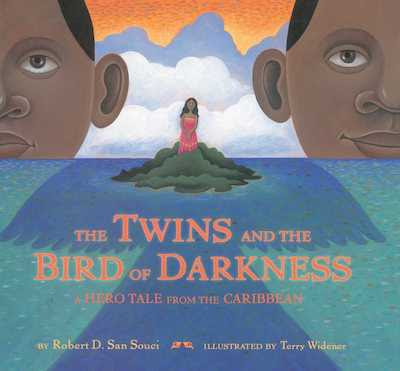
African Diaspora at Internet Archive: Twins and the Bird of Darkness

In yesterday's blog post, I wrote about the collaboration between Brian Pinkney and Robert San Souci, and I wanted to say something more about San Souci today, looking at another book that, like his Cendrillon, is inspired by a Caribbean folktale: The Twins and the Bird of Darkness: A Hero Tale from the Caribbean.


The lovely illustrations are by Terry Widener. Here is the monstrous bird that the hero must defeat; if you look closely, you can see the hero and also the princess imprisoned in the tree where the bird lives, casting darkness over the land with his huge wings:


As San Souci explains in the note to the story, he was inspired by version sof this story collected by Elsie Clews Parsons on the island of Guadeloupe which she labeled as "Twin Brothers: Seven Tongues" and also "The Beast That Keeps the Country Dark." Click on the image to read more; Parsons provides this type of comparative bibliography for all the story types; it's so useful! You can see both African and European and other parallel versions listed there, along with additional Caribbean versions:


San Souci also borrowed from Philip Sherlock's West Indian Folktales, which is also available at the Internet Archive! Philip Sherlock was an important educator and writer from the Caribbean; I'll have more to say about him in future posts!


The world of Caribbean storytelling is a wonderful place to explore, and I'll have more Caribbean story books to share in the coming weeks. Meanwhile, enjoy!

Sunday, March 27, 2022

African Diaspora at Internet Archive: Brian Pinkney

Since I wrote about a book illustrated by Brian Pinkney in yesterday's post, I wanted to follow up with another one of his books today: Cendrillon: A Caribbean Cinderella by Robert  San Souci.


This is from a Creole version of Cinderella, and be sure to look at the Creole glossary in the back along with the author's note about his sources.

The illustrations by Brian Pinkney are beautiful!


I also wanted to share another book that Brian Pinkney illustrated; it's not folklore, but instead poetry by Langston Hughes: The Dream Keeper and Other Poems.


You can find out more about the great poet Langston Hughes at Wikipedia; how I wish he could have lived to see this beautiful book. You might recall that I wrote an earlier post about an anthology of African American folklore that Hughes edited: The Book of Negro Folklore.

Here's Pinkney's illustration for a poem about Jim Crow and merry-go-rounds: there ain't no back / to a merry-go-round.


I think it's wonderful to see how Brian Pinkney developed his own very distinctive style, just as his father, Jerry Pinkney, developed his own style over the years (more from Jerry Pinkney).


by Robert  San Souci


by Langston Hughes


Saturday, March 26, 2022

African Diaspora at Internet Archive: Drums / Kizell

I took a week off to finish proofreading and doing the layout for the Reader's Guide to African Folktales at the Internet Archive... which means I was so glad to be able to get back to writing about books here today! Instead of the weekly roundup that I usually do on Saturday, I'll just include a link here to the Elsie Clews Parsons books (plus spreadsheet) from last week, and jump right in with new books for a new week, both of them Gullah-related.

The first is a beautiful and deeply moving children's book by Kim Siegelson: In the Time of the Drums.


You can find out more about Kim Seigelson here: Georgia Center for the Book.

The wonderful illustrations are by Brian Pinkney, who is the son of Jerry Pinkney. (You might remember him from an earlier post: he did the illustrations for McKissack's The Dark Thirty!)


As the author explains in a note after the story, this is a Gullah legend told throughout the Sea Islands off the South Carolina and Georgia coast. I don't want to give away too much, but if you know the legend of the flying Africans (see Virginia Hamilton's The People Could Fly), you will see this as a kindred story.

The other book I want to share today is not folklore, but actual history, an amazing investigation into the life of John Kizell: The African American Odyssey of John Kizell: A South Carolina Slave Returns to Fight the Slave Trade in His African Homeland by Kevin Lowther.


Doesn't that subtitle make you want to read the book? It is a remarkable real-life story; you can also read about John Kizell at Wikipedia. By chance I met Kevin Lowther's brother this week, and he told me about the book; I am so grateful for that chance meeting! If you are interested in American or African history (or even Canadian history!), the history of slavery and of the fight against slavery, and also the history of Gullah culture in South Carolina, then this is a book for you. To find out more about Kevin Lowther and the historical research that made this book possible, here's a podcast to listen to: Research at the National Archives.


And now I have to say: it feels GREAT to be writing about books again every day here after a week off, and, yes, there will eventually be a Reader's Guide to African Diaspora Folktales at the Internet Archive, a follow-up to the African folktales book too. But I've got a lot of blogging to do before I get there. :-)

by Kim Siegelson


by Kevin Lowther